This post may contain affiliate links. Please see our disclosure policy.
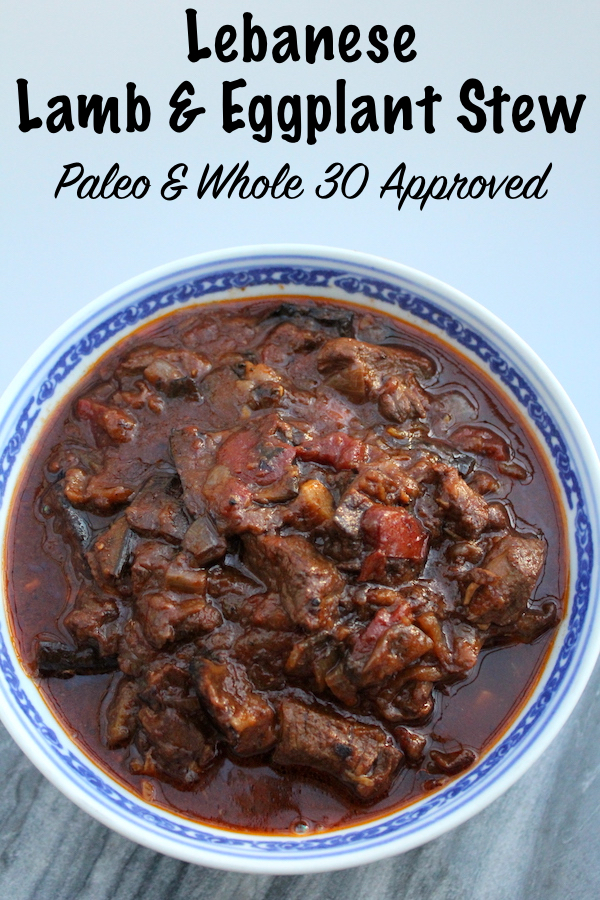
Lebanese lamb stew with eggplant combines two traditional Lebanese ingredients into a tasty stew. Warm spices such as nutmeg and cinnamon turn this savory lamb stew into something truly special.
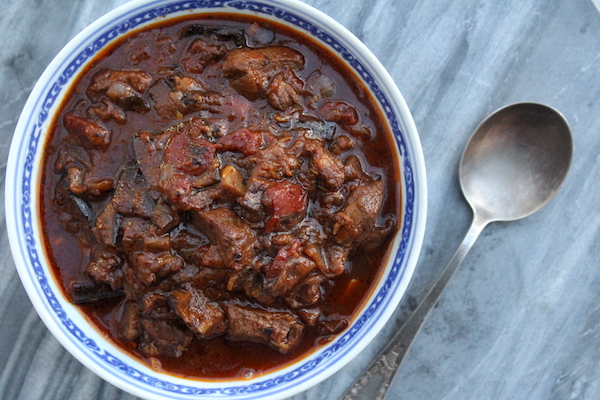
Table of Contents
- Notes from My Kitchen
- Ingredients for Lebanese lamb stew with eggplant
- How to make lamb and eggplant stew
- Slow cooker vs. Dutch oven
- Tips for the best lamb and eggplant stew
- Variations
- Serving Lebanese lamb stew
- Lamb and eggplant stew FAQs
- More Middle Eastern recipes
- Lamb Stew with Eggplant Recipe
- More soups and stews
There’s something really satisfying about eggplants. They soak up flavors like nobody’s business, and it’s no wonder they’re a staple of Middle Eastern cooking. We’ve been slowly working our way through The Lebanese Kitchen, which has dozens of eggplant recipes along with nearly 100 tasty lamb recipes.
What I love about this particular recipe are all the warm spices. Cinnamon and nutmeg combine with the earthy flavors of lamb, and a bit of tomato adds brightness and acidity.
The method is a straightforward braise that works two ways. You roast the eggplant separately so it holds its shape, brown the lamb, build the sauce in the same pot, and then let it go low and slow in either a Dutch oven or a slow cooker. Roasting the eggplant first is the step people skip, and it is the step that decides whether you get distinct cubes of eggplant or a purée.
This recipe has been on Adamant Kitchen since 2018 and readers have been cooking it and reporting back ever since, with ground lamb meatballs, with chickpeas instead of lamb, with lentils, with red peppers, and with the stock cut back for a thicker sauce. Almost all of those adjustments are in this post now, because the comments turned out to be a better guide to what people actually want to know than anything I could have guessed.
If eggplant is what brought you here, my collection of 60+ eggplant recipes covers everything from breakfast to dessert. And if you want the same warm spicing without the meat, the Lebanese butternut squash stew is the vegan slow cooker version of this idea. Full amounts are in the recipe card at the bottom of this post.
Notes from My Kitchen

This particular stew is mildly spiced and it’s great for kids. My three-year-old daughter says “this is the best soup ever!” I’m not quite going to go that far, but it is darn tasty. Later that day she told me, “Mama, your restaurant serves the best food. I love your restaurant.”
I think she’s just buttering me up for more cookies. None the less, I’ll take it!
The thing I got wrong the first several times was the eggplant. I roasted it, then dumped it in with everything else at the start of a long slow cooker day, and by dinner there was no eggplant left in the pot, just a thick, silky sauce that tasted wonderful and looked like nothing in particular. It is still good that way. But if you want to see the eggplant on the spoon, roast it early and hold it back until the last stretch of cooking, which is how the recipe card is written now.
Ingredients for Lebanese lamb stew with eggplant
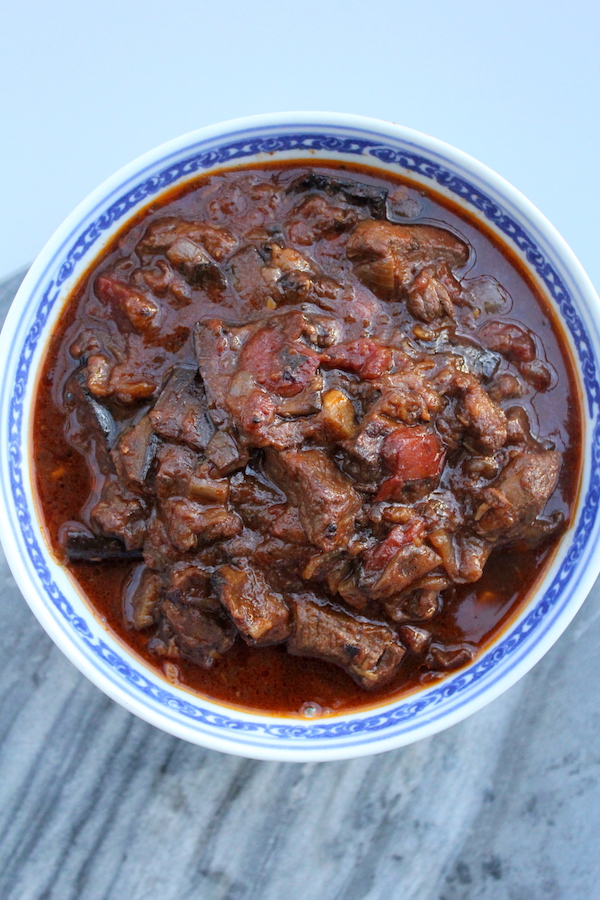
Sixteen ingredients, most of them already in your spice drawer. The order matters more than usual here: the eggplant roasts on its own before anything else happens, the lamb browns before the aromatics, and the tomato paste goes into the hot pot for a minute before any liquid touches it. You will need a heavy Dutch oven or a slow cooker, plus a rimmed sheet pan for the eggplant. Exact amounts are in the recipe card.
- Eggplant: One large globe eggplant, cut into big cubes so they survive the braise. Smaller Italian or graffiti eggplants work and have thinner skin and fewer seeds. Leave the skin on; it is what holds the cubes together once they go into the pot.
- Olive oil: Divided three ways, and eggplant will take most of what you give it. Use a plain everyday olive oil for the roasting and browning rather than a good finishing oil, which is wasted at these temperatures.
- Lamb: Boneless shoulder, cut into cubes. Shoulder has the connective tissue that turns silky over a long braise; leg is leaner and can go dry and stringy at the far end of the cooking time. Stewing goat works identically, as it does in Portuguese chanfana.
- Onion and garlic: The base of the sauce. Dice the onion rather than slicing it, since slices stay visible as strands after hours of cooking and dice disappear into the body of the stew.
- Red wine: Goes into the hot pan after the lamb comes out, to lift the browned bits off the bottom. Any dry red you would drink is fine. To skip it, use an equal amount of extra stock plus a splash of pomegranate molasses or red wine vinegar for the acidity.
- Tomato paste: Concentrated depth and the reason the sauce tastes deep rather than thin. It needs to cook in the hot pot for about a minute before liquid is added, or it keeps a raw, tinny edge that will dominate the finished stew.
- Canned or fresh tomatoes: Chopped, with their juice. One standard supermarket can is what this is built around, so do not drain it. In late summer, an equal weight of peeled fresh tomatoes is better, and any variety works since it is all going to break down anyway.
- Lamb or beef stock: The braising liquid. Lamb stock is the traditional choice and worth making if you have bones, the way the broth builds itself in Icelandic lamb soup. Beef stock is the everyday substitute, and chicken stock works if that is what is open.
- Bay leaf: Do not leave it out. It sounds inconsequential in a pot with cinnamon and allspice in it, but it is what keeps the lamb tasting like lamb underneath all of the sweet spice. Remove it before serving.
- Black pepper: This recipe uses considerably more than most stews, and it is deliberate. The pepper is a counterweight to the cinnamon and nutmeg, so the dish stays savory instead of turning sweet. Freshly cracked is noticeably better here than pre-ground.
- Thyme: Dried thyme, added at the start. If you are using fresh, triple the amount and add it in the last hour, since fresh thyme cooks away to nothing over a long braise.
- Cinnamon: A whole stick if you have one, ground if you do not. The stick gives a rounder, less insistent cinnamon flavor and is easy to fish out at the end. Ground cinnamon tastes sweeter and stronger, so it is the choice that pushes the stew toward dessert territory if you are heavy handed with it.
- Allspice and nutmeg: The pair that makes this taste Lebanese rather than generically Mediterranean. Grate the nutmeg fresh if you can; a whole nutmeg and a microplane grater give you something bright and resinous that the pre-ground jar simply does not have.
- Salt: Season the lamb before browning as well as salting the pot, and taste again at the end. Eggplant absorbs an enormous amount of seasoning, so a stew that tasted right before the eggplant went in will taste flat afterward.
- Fresh parsley: Chopped and stirred in at the table, not during cooking. This is not a garnish you can skip. After four hours of warm spice, the raw parsley is the only fresh, green thing in the bowl and it resets the whole dish.
A note on the eggplant: Modern globe eggplants are bred for low bitterness and do not need to be salted and drained the way older varieties did. What they do need is dry heat before they go into liquid. An eggplant cube that goes into a braise raw will absorb stock and collapse into the sauce within an hour or two. A cube that has been roasted at 400°F first has driven off some of its water and set its structure, and it holds together. If your eggplant is very large, very seedy, or past its prime, a 30 minute salt and drain will improve it, but for an ordinary supermarket eggplant it is a step you can skip.
A note on the lamb: Ask the butcher for shoulder rather than buying pre-cut stew meat, which is usually trim from several cuts and cooks unevenly. Cut it yourself into pieces about an inch across, and do not trim off all of the fat; it renders out over the braise and carries the spice. If lamb is hard to find or expensive where you are, this works with goat, with beef chuck, and with lamb neck, which is the cheapest cut on the animal and one of the best for stewing.
How to make lamb and eggplant stew
The active work is about 30 minutes at the stove, and then the pot does the rest. Read through to step 7 before you start, because the eggplant is roasted early and then held back until the last stretch, which is the one part of the timing that is not obvious.
Step 1. Roast the eggplant. Heat the oven to 400°F (200°C). Cut the eggplant into 1 1/2 inch cubes, toss them with 2 tablespoons of the olive oil on a rimmed sheet pan, and spread them out in a single layer with space between them. Roast for 20 minutes, until the edges are browned and the cubes have shrunk noticeably. Set them aside; they do not go into the pot yet.
Step 2. Brown the lamb. Pat the lamb cubes dry and season them with about half the salt and half the pepper. Heat 2 tablespoons of olive oil in a heavy Dutch oven over medium-high heat and brown the lamb on at least two sides, working in two batches so the pan stays hot. Crowded lamb steams instead of browning, and the browning is where a large share of the flavor comes from. Transfer the lamb to a plate.
Step 3. Cook the onion and garlic. Lower the heat to medium, add the last 2 tablespoons of olive oil, and cook the diced onion until it is tender and just starting to brown, about 8 minutes. Add the minced garlic and cook for one more minute, until you can smell it.
Step 4. Cook the tomato paste. Stir the tomato paste into the onions and let it cook for about a minute, until it darkens from bright red to brick and smells sweet rather than sharp. This one minute is the difference between a sauce with depth and a sauce that tastes like the inside of a tomato paste can.
Step 5. Deglaze with the red wine. Pour in the wine and scrape the bottom of the pot with a wooden spoon to lift every browned bit. Let it bubble for 2 to 3 minutes until the harsh alcohol smell is gone and the liquid has reduced by about half.
Step 6. Add the lamb, tomatoes, stock and spices. Return the lamb and any juices on the plate to the pot. Add the chopped tomatoes with their juice, the stock, the bay leaf, the thyme, the cinnamon, the allspice, the nutmeg, and the remaining salt and pepper. Stir, and bring it just to a simmer. If you are using a slow cooker, this is the point where everything transfers over.
Step 7. Braise, then add the eggplant for the last stretch. Cover and cook gently: 2 1/2 to 3 hours at a bare simmer in a Dutch oven, or 4 to 8 hours on low in a slow cooker. Add the roasted eggplant for the final 1 1/2 to 2 hours of whichever method you are using. The lamb is done when a cube falls apart under light pressure from a spoon.
Step 8. Finish and serve. Fish out the bay leaf and the cinnamon stick. Taste and add salt, since the eggplant will have taken up a good deal of it. Stir the chopped fresh parsley in at the table, or scatter it over each bowl, and serve with warm pita.
Slow cooker vs. Dutch oven
Both methods make a good stew and they make slightly different stews, so the choice is worth thinking about rather than defaulting to whichever pot is clean.
The Dutch oven gives you a thicker, more concentrated sauce, because a heavy pot with the lid slightly ajar lets some liquid evaporate over three hours. It also needs watching. A stovetop burner on its lowest setting still varies a great deal between ranges, and this stew has only 2 cups of stock in it, so a burner that runs hot will scorch the bottom. If your stove will not hold a bare simmer, move the covered pot into a 325°F oven instead and give it the same 2 1/2 to 3 hours. The oven surrounds the pot with even heat and there is nothing to scorch against.
The slow cooker is the hands-off option and the one I use on a weekday. Nothing evaporates from a sealed slow cooker, so the sauce stays looser than the Dutch oven version. If you want it thick, cut the stock back to 1 to 1 1/2 cups, or take the lid off for the last 30 minutes on high. You still brown the lamb and cook the tomato paste in a skillet first; a slow cooker cannot brown, and skipping that step costs you most of what makes this taste like a braise instead of a soup.
A pressure cooker is not the traditional route but it works when you have decided on this at 5 p.m. Use the sauté function on an Instant Pot for steps 2 through 5, pressure cook the lamb and sauce on high for 30 minutes with a natural release, then stir in the roasted eggplant and simmer on sauté for 10 minutes to finish. The texture is very close and the flavor is a shade less developed.
Tips for the best lamb and eggplant stew
Make it a day ahead. This is one of those stews that is measurably better on day two, and readers here say so repeatedly. The spices settle, the sauce thickens as it cools, and the lamb keeps absorbing the braising liquid overnight. If you are cooking for company, make it the day before, refrigerate it, and reheat it gently on the stovetop. Add the parsley only when you serve.
Do not skip cooking the tomato paste. Three tablespoons of tomato paste stirred straight into liquid stays sharp and metallic for the entire braise, and it will be the loudest thing in the bowl. One minute in the hot, oily pot before the wine goes in turns it deep and slightly sweet. This is the single most common reason a batch of this comes out tasting tomato-forward instead of spiced.
Adjust the stock to the sauce you want. Two cups gives a brothy, spoonable stew that wants pita or rice underneath it. One cup gives something closer to a thick braise you could serve on a plate. Both are correct, and the right answer depends on whether you are treating it as a soup or as a main course. Cut back before cooking rather than trying to reduce a slow cooker’s sauce afterward.
Toast whole spices if you are using them. If you have whole allspice berries and a cinnamon stick rather than the ground versions, drop them into the dry pot for 30 seconds before you add the oil in step 2. It is the same principle that makes the spice base of saç kavurma, Turkish sautéed spiced lamb taste the way it does, and it costs you nothing but half a minute.
Salt at the end, not just at the start. Roasted eggplant is a sponge and it goes into a pot that was already seasoned. Almost every time this comes out tasting slightly flat, the fix is a good pinch of salt stirred in five minutes before serving, not more spice.
Variations
Most of these came from readers who cooked the recipe and then wrote to say what they did differently, which is the best kind of variation there is.
- Ground lamb meatballs: Roll 1 pound of ground lamb into cube-sized meatballs, brown them, and add them for the last 30 to 45 minutes instead of braising them for hours. Ground lamb is often cheaper and easier to find than shoulder, and the stew is arguably better for it.
- Vegetarian, with chickpeas: Leave out the lamb, use vegetable stock, stew the eggplant, tomatoes and onions for 1 1/2 to 2 hours, and stir in 1 1/2 to 2 cups of cooked chickpeas for the last half hour. For a version built to be meatless from the start, make the Lebanese butternut squash stew instead.
- With lentils: A cup of cooked brown or green lentils added in the last 30 minutes stretches a small amount of lamb into a full pot and adds body without changing the flavor. Lentils and lamb are a classic pairing, as in lamb dhansak.
- With sweet red peppers: Two red bell peppers, cut into wide strips and added with the eggplant, bring sweetness and color. This pushes the stew toward the Syrian end of the region, the way Syrian cauliflower stew with lamb goes.
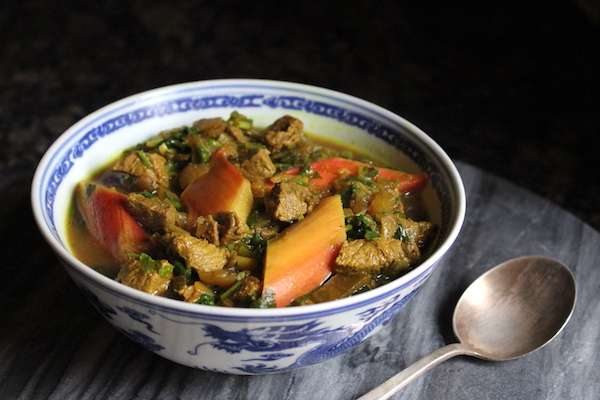
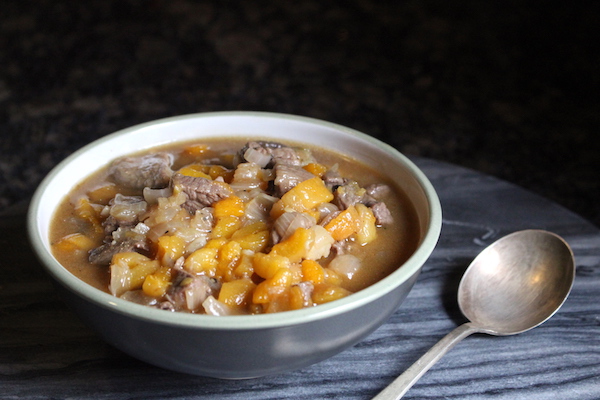
- Swap the vegetable: The spiced lamb base underneath this works with almost any sturdy vegetable. Rhubarb in the spring gives you Persian lamb and rhubarb stew, and dried apricots give you Turkish lamb and apricot stew.
- With slivered almonds: A handful of slivered almonds, toasted dry in a skillet and scattered over the bowls with the parsley, adds crunch against a stew where everything else is soft. Pine nuts do the same job and are the more traditional Lebanese choice.
Serving Lebanese lamb stew
Warm pita is the traditional accompaniment and the one I default to, torn and used to scoop rather than set alongside as bread. Beyond that, this wants something starchy underneath it to catch the sauce: plain rice, rice pilaf with vermicelli, bulgur, or in a Vermont winter, buttered egg noodles, which is not traditional in any sense but is very good.
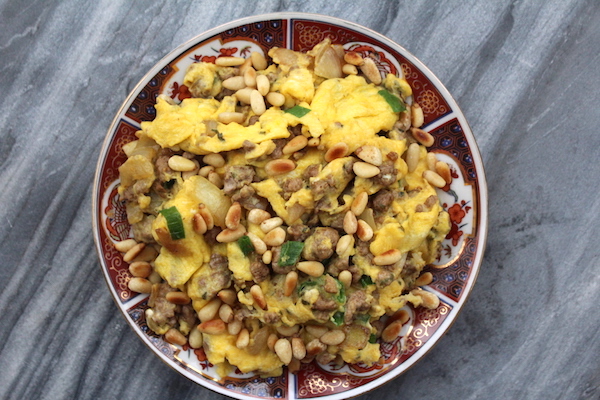
To finish the bowls, use plain yogurt or labneh spooned on top, which cools the spice and looks striking against the dark sauce; a squeeze of lemon; toasted pine nuts; and always, the chopped parsley. A simple cucumber and tomato salad with lemon and mint on the side is the standard companion, and it keeps the meal from being uniformly soft and warm. If you are building out a whole Lebanese spread, Lebanese eggs with lamb and pine nuts uses the same spice logic in a much faster dish.
Storage: Cooled and covered, this keeps in the refrigerator for 4 days and improves for the first two of them. It freezes well for up to 3 months in an airtight container; the eggplant softens further on thawing, so if you know a batch is headed for the freezer, that is the batch to make with the eggplant added at the start and let it dissolve into the sauce on purpose. Thaw overnight in the refrigerator.
Reheating: Reheat gently on the stovetop over low heat with a splash of stock or water, since the sauce thickens considerably in the refrigerator. Avoid a hard boil, which will break the eggplant down. Add fresh parsley to the reheated stew rather than reusing the parsley from the first day, which will have gone dark and lost its point.
This was so good and I will be making it again and again. I made it exactly per the recipe using the stove top/dutch oven directions. The spices are so warm, but not hot, with the black pepper, cinnamon, allspice and nutmeg.
Lamb and eggplant stew FAQs
Four, as a main course with pita or rice, which works out to about 1 1/2 cups per person. It will stretch to six smaller bowls if you are serving it as a first course or alongside several mezze dishes. If you want six full servings, the recipe doubles cleanly in a 6 quart Dutch oven or slow cooker with no change to the cooking time.
Not with a standard supermarket globe eggplant, which is bred for low bitterness and does not need drawing out. What matters far more is roasting it before it goes into liquid, because that drives off water and sets the structure so the cubes hold their shape. If your eggplant is very large, very seedy, or has been sitting in the crisper for a week, salt the cubes for 30 minutes and pat them dry first.
Yes. Replace the 1/2 cup of wine with an equal amount of stock and add about a teaspoon of red wine vinegar or pomegranate molasses at the end, which restores the acidity the wine was providing. Still deglaze the pot with the liquid, since the point of that step is lifting the browned bits off the bottom rather than the alcohol itself. Pomegranate molasses is the more Lebanese answer and it is worth keeping a bottle around.
This happens most often in a slow cooker, where nothing evaporates. Take the lid off and cook on high for the last 30 minutes, or transfer the stew to a wide pot and simmer it uncovered for 10 to 15 minutes. Next time, start with 1 to 1 1/2 cups of stock instead of 2. You can also mash a few of the roasted eggplant cubes against the side of the pot, which thickens the sauce with what is already in it rather than adding starch.
Yes, and it is one of the most common changes readers make. Roll the ground lamb into small meatballs about the size of the lamb cubes, brown them in the pot, and set them aside rather than braising them for hours. Add them back for the final 30 to 45 minutes along with the roasted eggplant. Long braising is for breaking down connective tissue, and ground lamb has none left to break down, so it only dries out.
More Middle Eastern recipes
If you tried this Lebanese Lamb Stew with Eggplant recipe, or any other recipe on Adamant Kitchen, leave a ⭐ star rating and let me know what you think in the 📝 comments below!
And make sure you stay in touch with me by following on social media!
Lamb Stew with Eggplant
Equipment
- Heavy soup pot or Dutch oven, 6 quart or larger
- Rimmed Baking Sheet
- Microplane Grater
Ingredients
- 1 large eggplant, cut into 1 1/2 inch cubes
- 6 tbsp olive oil, divided
- 1 lb lamb, boneless and cubed into 1 inch pieces
- 1 large onion, diced
- 3-4 cloves garlic, minced
- 1/2 cup red wine
- 3 tbsp tomato paste
- 14 oz tomatoes, canned chopped tomatoes, or fresh
- 2 cups lamb or beef stock
- 1 medium bay leaf
- 2 tsp pepper
- 1 tsp thyme
- 1 medium cinnamon stick, or 1 tsp ground cinnamon
- 1/2 tsp allspice, ground
- 1/2 tsp nutmeg, preferably freshly grated
- 1 tsp salt
- fresh parsley to finish, chopped
Instructions
- Preheat the oven to 400 F (200 C). Toss the eggplant cubes with 2 Tbsp of the olive oil on a rimmed baking sheet and spread them in a single layer. Roast for 20 minutes, until browned at the edges and visibly shrunken. Set aside; the eggplant does not go into the pot yet.
- Pat the lamb dry and season it with about half the salt and half the pepper. Heat 2 Tbsp olive oil in a heavy Dutch oven over medium-high heat and brown the lamb on at least two sides, working in two batches so the pan stays hot. Transfer to a plate.
- Lower the heat to medium and add the last 2 Tbsp olive oil. Cook the diced onion until tender and just starting to brown, about 8 minutes. Add the garlic and cook 1 minute more.
- Stir in the tomato paste and cook for about 1 minute, until it darkens from bright red to brick and smells sweet rather than sharp.
- Pour in the red wine and scrape the bottom of the pot to lift the browned bits. Simmer 2 to 3 minutes, until reduced by about half.
- Return the lamb and any juices to the pot. Add the tomatoes with their juice, the stock, bay leaf, thyme, cinnamon, allspice, nutmeg, and the remaining salt and pepper. Stir and bring just to a simmer. Transfer to a slow cooker now if you are using one.
- Cover and cook gently, either 2 1/2 to 3 hours at a bare simmer in the Dutch oven or 4 to 8 hours on low in a slow cooker. Add the roasted eggplant for the final 1 1/2 to 2 hours. The lamb is done when a cube falls apart under light pressure from a spoon.
- Remove the bay leaf and cinnamon stick. Taste and add salt, since the eggplant absorbs a good deal of it. Stir in chopped fresh parsley at serving time and serve with warm pita.
Notes
Nutrition
Nutrition information is automatically calculated, so should only be used as an approximation.
More soups and stews
Looking to expand your soup and stew collection? Try these recipes for bowls of comfort.
- Icelandic lamb soup (kjötsúpa)
- Finnish salmon soup (lohikeitto)
- Icelandic fish stew (plokkfiskur)
- Nettle soup with potatoes and leeks
- Persian lamb and rhubarb stew
- Turkish lamb and apricot stew
- Portuguese chanfana, braised goat or lamb
- Syrian cauliflower stew with lamb
Find the perfect recipe
Searching for something else? Enter keywords to find the perfect recipe!
Spicing was terrific! Didn’t have much lamb so I added a cup of cooked green lentils in last 30 min which was a nice complement.
That sounds delicious!
This is delicious! I think of it as eggplant stew and follow the exact directions for that I used the “sauté” function in my slow cooker to brown the egplant rather than the oven (it’s hot here), but each of the two times I’ve made it have not used the cubed lamb. First time, I wanted something vegeatrian so substituted chickpeas that I had cooked from dried; second time, I had ground lamb that needed to be used so made and baked small meatballs. In both cases, I stewed the eggplant, tomato, and oninons for 1.5 to 2 hours in the slow cooker and then added the chickpeas or meatalls for the last half hour or so (since I wasn’t trying to tenderize cubed lamb). Like so many stuews, this is even better after a day or two.
Fantastic combination of flavors. Will be making again.
Just made this and it was delicious! I made it in the slow cooker and only added 1 cup of stock as I prefer a thicker consistency and it was perfect. I added a couple of red peppers too. I will definitely be making this again 😊
Lovely, so glad you enjoyed it!