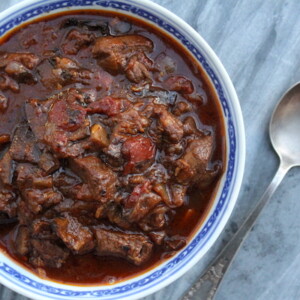
Lamb Stew with Eggplant
Lebanese lamb stew with eggplant combines two traditional Lebanese ingredients into a tasty stew. Warm spices such as nutmeg and cinnamon turn this savory lamb stew into something truly special.
Servings: 4 servings
Equipment
- Heavy soup pot or Dutch oven, 6 quart or larger
- Rimmed Baking Sheet
- Microplane Grater
Ingredients
- 1 large eggplant cut into 1 1/2 inch cubes
- 6 tbsp olive oil divided
- 1 lb lamb boneless and cubed into 1 inch pieces
- 1 large onion diced
- 3-4 cloves garlic minced
- 1/2 cup red wine
- 3 tbsp tomato paste
- 14 oz tomatoes canned chopped tomatoes, or fresh
- 2 cups lamb or beef stock
- 1 medium bay leaf
- 2 tsp pepper
- 1 tsp thyme
- 1 medium cinnamon stick or 1 tsp ground cinnamon
- 1/2 tsp allspice ground
- 1/2 tsp nutmeg preferably freshly grated
- 1 tsp salt
- fresh parsley to finish chopped
Instructions
- Preheat the oven to 400 F (200 C). Toss the eggplant cubes with 2 Tbsp of the olive oil on a rimmed baking sheet and spread them in a single layer. Roast for 20 minutes, until browned at the edges and visibly shrunken. Set aside; the eggplant does not go into the pot yet.
- Pat the lamb dry and season it with about half the salt and half the pepper. Heat 2 Tbsp olive oil in a heavy Dutch oven over medium-high heat and brown the lamb on at least two sides, working in two batches so the pan stays hot. Transfer to a plate.
- Lower the heat to medium and add the last 2 Tbsp olive oil. Cook the diced onion until tender and just starting to brown, about 8 minutes. Add the garlic and cook 1 minute more.
- Stir in the tomato paste and cook for about 1 minute, until it darkens from bright red to brick and smells sweet rather than sharp.
- Pour in the red wine and scrape the bottom of the pot to lift the browned bits. Simmer 2 to 3 minutes, until reduced by about half.
- Return the lamb and any juices to the pot. Add the tomatoes with their juice, the stock, bay leaf, thyme, cinnamon, allspice, nutmeg, and the remaining salt and pepper. Stir and bring just to a simmer. Transfer to a slow cooker now if you are using one.
- Cover and cook gently, either 2 1/2 to 3 hours at a bare simmer in the Dutch oven or 4 to 8 hours on low in a slow cooker. Add the roasted eggplant for the final 1 1/2 to 2 hours. The lamb is done when a cube falls apart under light pressure from a spoon.
- Remove the bay leaf and cinnamon stick. Taste and add salt, since the eggplant absorbs a good deal of it. Stir in chopped fresh parsley at serving time and serve with warm pita.
Notes
Why the eggplant goes in late: Roasted eggplant added at the start dissolves into the sauce over a long braise. Held back for the last 1 1/2 to 2 hours, it stays in distinct cubes. Both versions taste good; add it at the start on purpose if you want a thicker, silkier sauce with no visible eggplant.
Dutch oven vs. slow cooker: The Dutch oven gives a thicker, more concentrated sauce because liquid evaporates. If your burner will not hold a bare simmer, move the covered pot to a 325 F oven for the same 2 1/2 to 3 hours rather than risk scorching; there are only 2 cups of stock in the pot. Nothing evaporates in a sealed slow cooker, so that version stays looser.
Thickness: For a thicker stew, use 1 to 1 1/2 cups of stock instead of 2, or cook uncovered on high for the last 30 minutes. Mashing a few eggplant cubes against the side of the pot thickens the sauce without adding starch.
Substitutions: Goat, beef chuck, or lamb neck all work in place of lamb shoulder. For ground lamb, roll it into small meatballs, brown them, and add them for the last 30 to 45 minutes. For a vegetarian version, leave out the lamb, use vegetable stock, and add 1 1/2 to 2 cups of cooked chickpeas for the last half hour. To skip the wine, use an equal amount of stock plus about 1 tsp of red wine vinegar or pomegranate molasses at the end.
Seasoning: The 2 tsp of black pepper is deliberate and higher than most stews; it balances the cinnamon and nutmeg so the dish tastes savory rather than sweet. Taste and salt again after the eggplant has gone in, since it absorbs seasoning heavily.
Storage: Refrigerate up to 4 days, and it improves for the first two. Freeze up to 3 months. Reheat gently on the stovetop with a splash of stock, avoiding a hard boil, which breaks the eggplant down. Add fresh parsley to reheated portions rather than reusing the first day's.
Nutrition
Serving: 4Servings | Calories: 613kcal | Carbohydrates: 20g | Protein: 22g | Fat: 48g | Saturated Fat: 15g | Polyunsaturated Fat: 5g | Monounsaturated Fat: 26g | Cholesterol: 83mg | Sodium: 754mg | Potassium: 997mg | Fiber: 7g | Sugar: 10g | Vitamin A: 1072IU | Vitamin C: 23mg | Calcium: 76mg | Iron: 3mg