This post may contain affiliate links. Please see our disclosure policy.
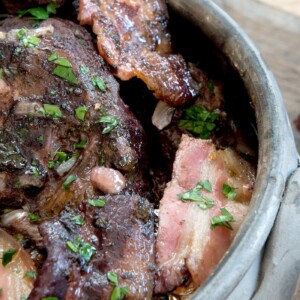
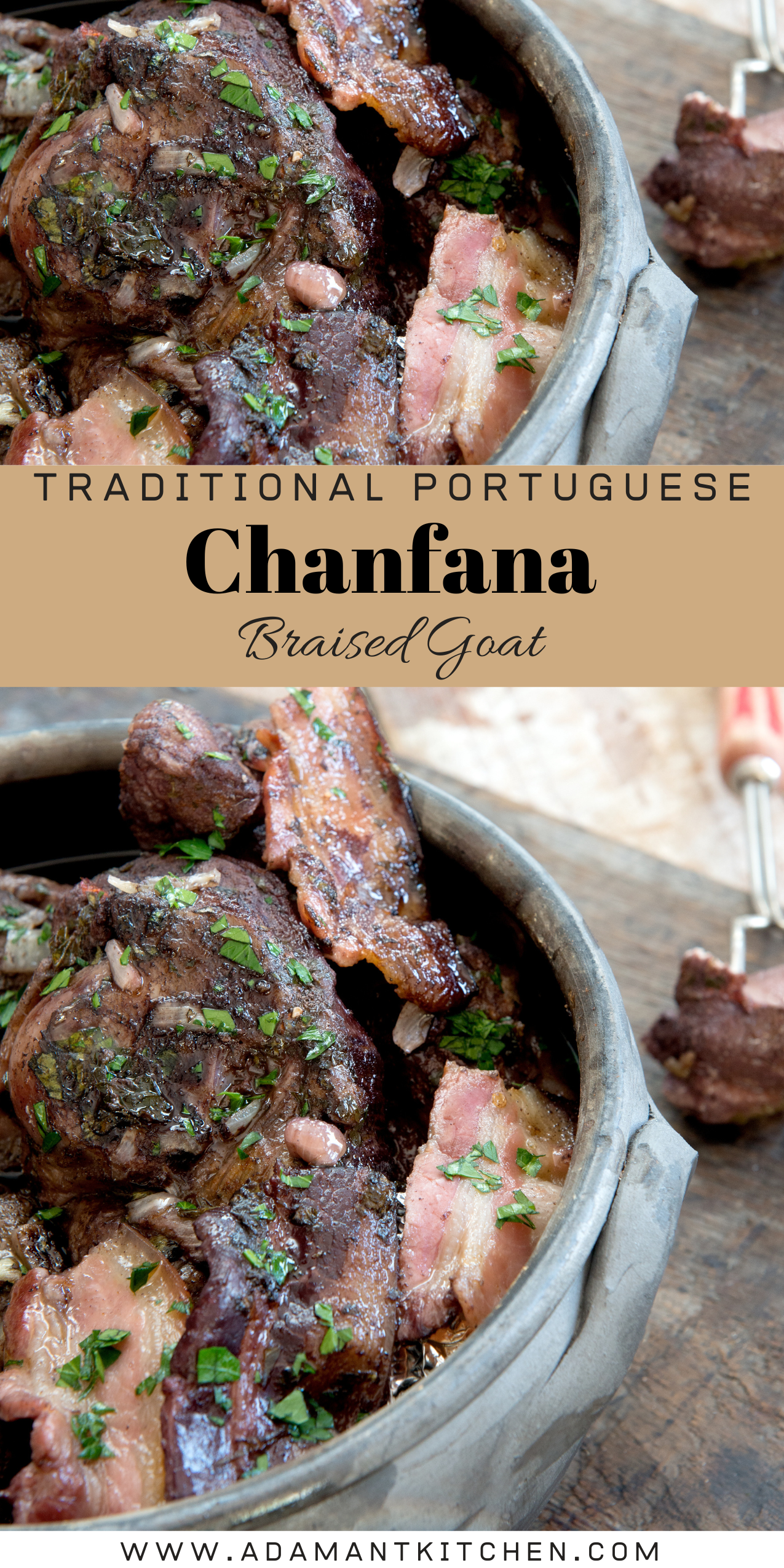
Portuguese chanfana is goat or lamb marinated overnight in red wine and then braised for three hours until it falls off the bone, and it is the celebration dish of Poiares, in central Portugal.
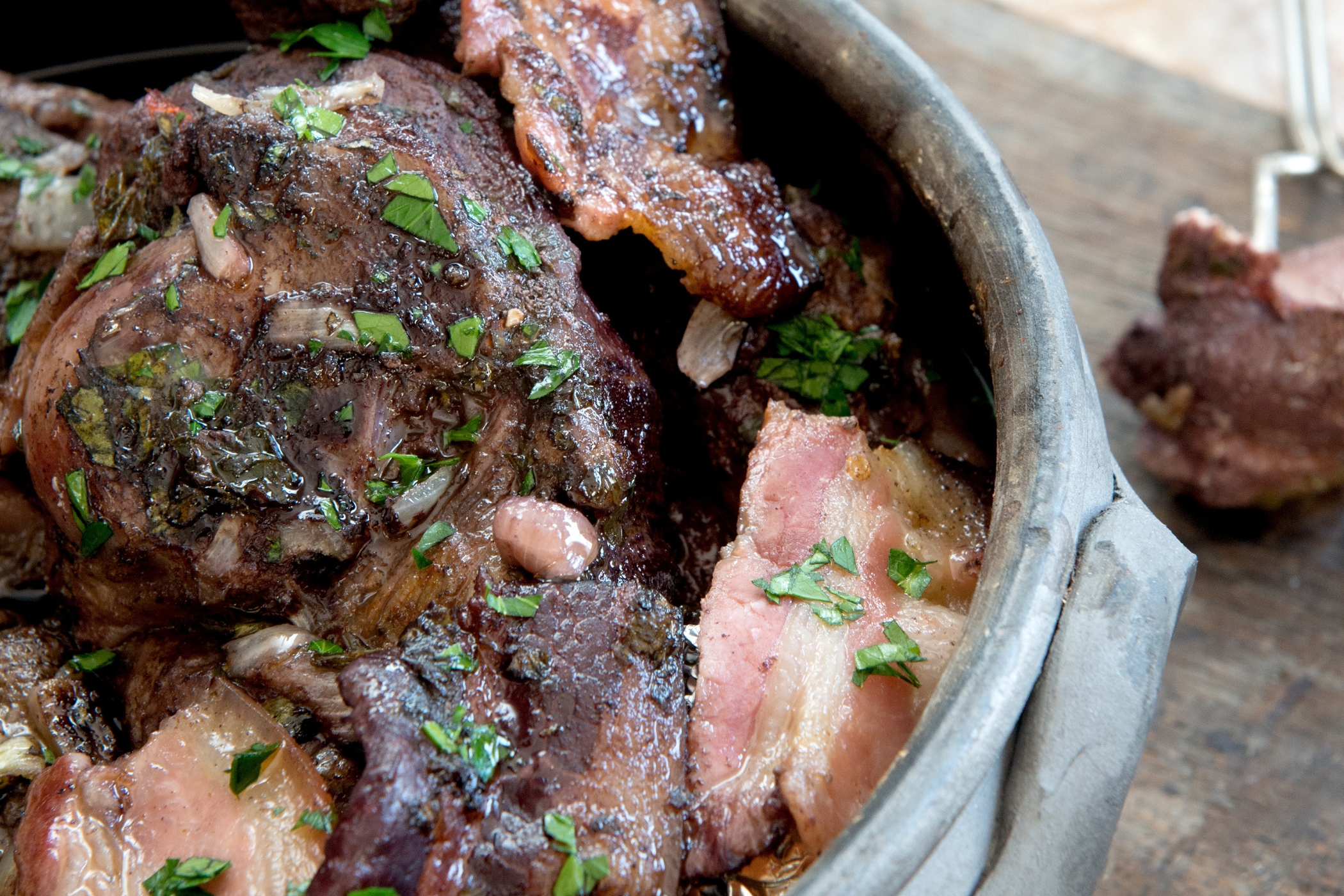
Table of Contents
- Notes from My Kitchen
- Ingredients for Portuguese chanfana
- How to make Portuguese chanfana
- Making chanfana in a dutch oven
- Tips for the best Portuguese chanfana
- Variations
- Serving Portuguese chanfana
- Portuguese chanfana FAQs
- More Goat & Lamb Recipes
- Portuguese Chanfana (Braised Goat or Lamb) Recipe
- More main course recipes
Chanfana is a two-day recipe that asks for about half an hour of actual work. The meat sits overnight in red wine with garlic, bay leaf, parsley and sweet paprika, then goes into a covered pot on a bed of onions with salt pork over the top and cooks low and slow until a fork slides through it. It is traditionally served at weddings and feast days, with boiled potatoes and crusty bread for the juices.
This is the traditional version, not a weeknight adaptation. It comes from Authentic Portuguese Cooking by Ana Patuleia Ortins, who adapted it from Lucy Neves in Poiares, the town that claims the best chanfana in Portugal. The technique is unusual by American standards: the meat is never browned, and there is no stock, no tomato and no thickener. The wine and the long, gentle heat do all of it.
Full amounts are in the recipe card at the bottom of the post. If you are cooking your way through Portugal, Portuguese rissois are the fried meat hand pies from the same book, and oven roasted goat ribs are the other long, slow goat recipe I keep coming back to.
Notes from My Kitchen

I have raised goats, and anyone who has will tell you the same thing: you end up with a great deal of meat from an animal that behaves nothing like lamb. Goat is leaner, the muscle is tighter, and an older animal will absolutely fight you if you try to cook it fast. So I have spent years collecting the traditional preparations, the ones that come from places where goat was never a novelty, and chanfana is the best of them.
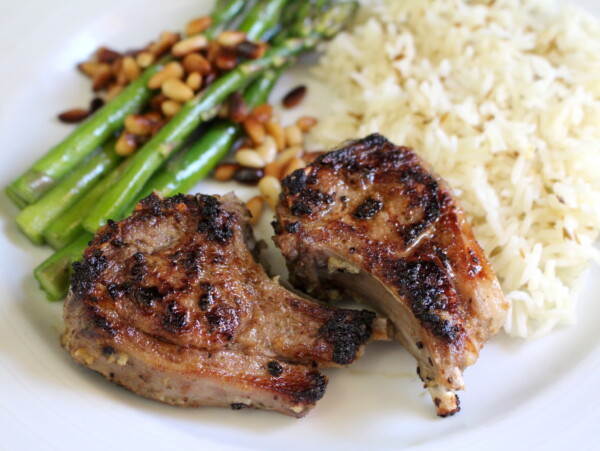
What sold me on it is that the recipe is built for exactly the animal I have. It wants an older goat, it wants three unhurried hours, and it rewards both. The meat comes out rich and deeply savory, the wine reduces into something closer to gravy than broth, and nobody at the table has to work at it. When I want something from the same animal in twenty minutes instead, I make goat chops with garlic and herbs instead.
Ingredients for Portuguese chanfana
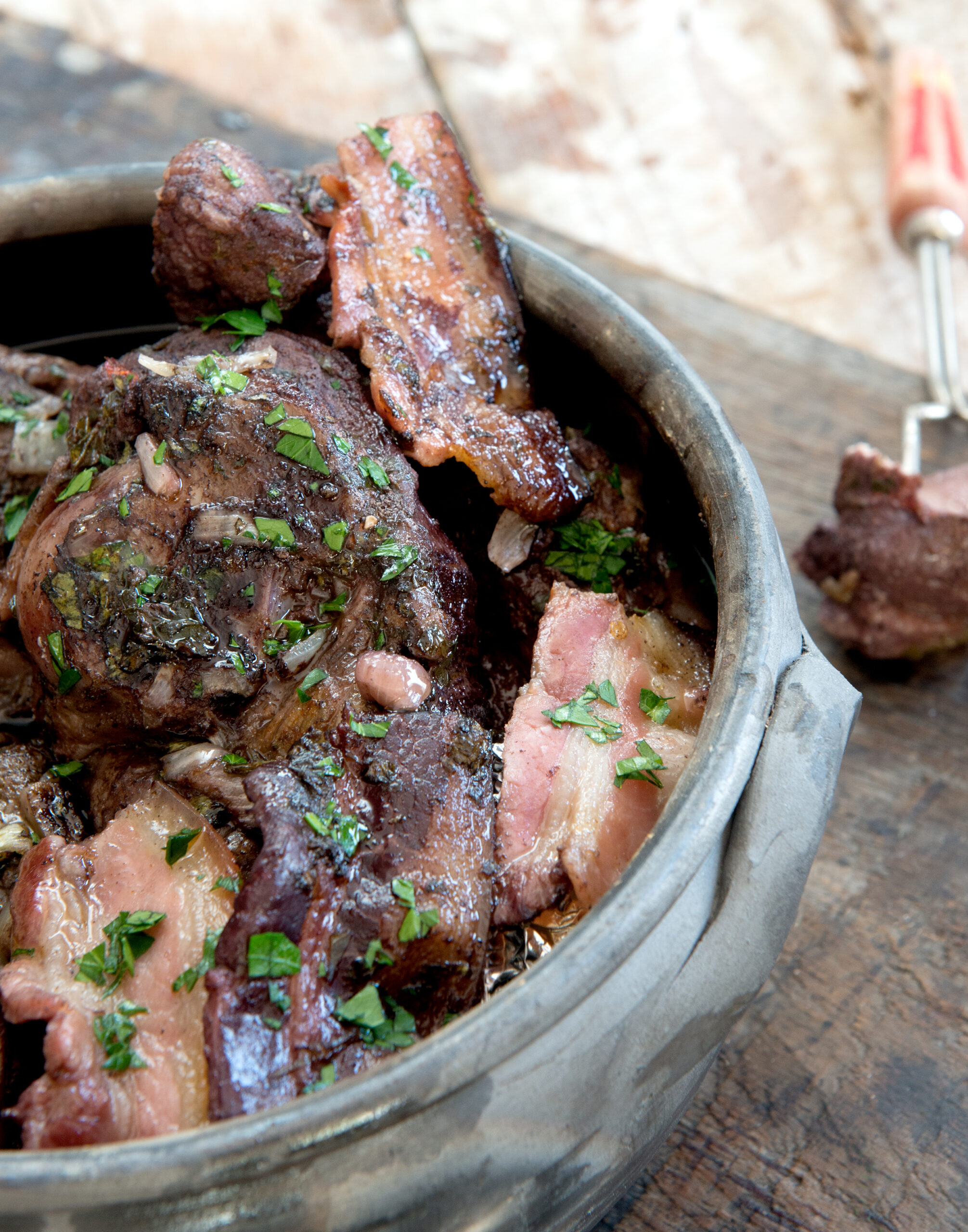
Twelve ingredients, and most of them go into the marinade the night before. There is no browning step and no stock, so the wine is both the marinade and the entire braising liquid, which means the amount is set by your pot rather than by a measuring cup: you want enough wine to come level with the top of the meat. Exact amounts are in the recipe card at the bottom of the post.
A note on the pot before you start: the traditional vessel is an unglazed black clay pot called a caçoilo, and a clay pot must always go into a cold oven. Putting one into a preheated oven can crack it, and a cracked pot in a hot oven with three cups of wine in it is a genuine mess. Any clay pot or roaster will work, and so will a dutch oven or a metal roasting pan, which is what most of us actually have.
- Goat or lamb: Leg meat is the standard cut, though shoulder and ribs work and give you more collagen, which is a good thing over three hours. Cut it into large chunks, roughly the size of a small fist, and leave the bones in.
- Garlic: Whole peeled cloves rather than minced. They go in with the marinade and slowly turn sweet and soft over the braise instead of scorching.
- Bay leaf: Broken in half so more of the cut edge is exposed to the wine. One large leaf is enough for the whole pot; bay turns medicinal if you overdo it.
- Fresh parsley: Coarsely chopped, stems and all. It goes in raw with the marinade and effectively dissolves into the sauce, so there is no point mincing it finely.
- Sweet paprika: This is the color in the finished dish and a good part of the flavor. Use sweet Spanish or Portuguese paprika, not hot and not smoked, unless you specifically want a smoky braise. The same principle is at work in German goulash soup, where paprika is doing the heavy lifting rather than playing a supporting role.
- Crushed dried chile pepper: A small amount, for warmth rather than heat. Portuguese cooks would reach for piri piri; crushed red pepper flakes are a fine stand-in.
- Coarse kosher salt: Use coarse kosher salt here, not table salt. Table salt packs roughly twice as much salt into the same spoon, and this is a large quantity going onto meat that cannot be tasted and corrected until three hours later.
- Red wine: The marinade, the braising liquid and the sauce, all in one. Use a dry red you would drink, nothing sweet and nothing labeled cooking wine. A young, rustic Portuguese red is the traditional choice and a Douro or Dão is easy to find.
- Olive oil: Drizzled over the top of the marinade, where it forms a layer that keeps air off the meat overnight. It also carries the paprika, which is fat soluble.
- Onion: Finely chopped and divided in two. Half makes a bed under the meat so nothing sits directly on the hot floor of the pot, and half goes over the top to melt down into the sauce.
- Fresh mint leaves: Optional, and only a couple of them. Mint is common in Portuguese braises and it reads as a background lift rather than anything you would identify as mint.
- Salt pork or bacon: Coarsely chopped and scattered over the top, where it renders down through everything below it. Goat is lean, and this is where the richness in the dish comes from. Unsmoked salt pork is closer to the original; bacon works and brings smoke with it.
On choosing your meat: this recipe is written for an older animal and it is worth honoring that. Baby goat, sold as cabrito, and lamb under about 15 pounds are too tender and too delicate for a three hour braise, and they will go stringy and dry long before the time is up. Ask a butcher for an older goat or a mature lamb, and if you are buying a whole animal, have it cut into portions before you take it home. If tender young meat is what you have, roast it instead.
On the wine: three cups is the starting point, but the real measure is that the wine should come level with the top of the meat in the pot you are using. A tall narrow pot needs less; a wide roasting pan needs more. Wine is expensive to guess wrong on, so pack the meat snugly rather than spreading it out, and pour until it just reaches the top.
How to make Portuguese chanfana
This is a two day recipe, and almost all of it is waiting. Day one is fifteen minutes of seasoning and pouring. Day two is ten minutes of assembly and then three hours where the oven does the work and you leave it alone.
Step 1. Season the meat, the day before. Put the chunks of goat or lamb in a large nonreactive bowl, glass or stainless steel rather than aluminum, since the wine is acidic enough to react. Add the whole garlic cloves, the halved bay leaf, the parsley, the paprika, the crushed chile and the salt, then turn the meat with your hands until every piece is coated.
Step 2. Cover it with wine and oil. Pour in the red wine until it comes level with the top of the meat, then drizzle the olive oil over the surface. The oil sits on top and seals the marinade, so do not stir it in.
Step 3. Marinate overnight. Cover the bowl and refrigerate it for at least 4 hours, and preferably a full 12 hours overnight. Turn the meat once or twice if you happen to be passing. The longer it sits, the more the finished dish tastes of wine, so overnight is the sweet spot and two days starts to get assertive.
Step 4. Set up the oven the next day. If you are using a clay pot, leave the oven off for now, set the temperature to 350°F (180°C) and put the loaded pot into the cold oven so it heats up along with it. If you are using a dutch oven or a metal roasting pan, preheat to 350°F (180°C) as usual.
Step 5. Build the pot. Spread half the chopped onion across the bottom in an even bed. Lift the meat on top of it, then pour every bit of the marinade in after it, garlic, bay, parsley and all. Scatter the remaining onion and the mint leaves over the meat, and finish with the chopped salt pork or bacon on the very top so it renders down through the whole pot.
Step 6. Cover tightly and cook for 2 1/2 hours. Use the pot’s lid if it has one, and cover it with heavy duty foil crimped hard around the rim either way. You are trapping steam, and a loose cover means the wine boils away and the top of the meat dries out. Do not open it to check.
Step 7. Uncover and cook another 20 to 30 minutes. Take off the foil and let the top of the meat darken and take on a crust in the dry heat. Spoon the pan juices over it two or three times during this stretch, which is what builds the glossy, almost lacquered surface.
Step 8. Check that it is genuinely fork tender. A fork should go into a chunk with no resistance and the meat should pull away from the bone on its own. If it still grips, cover it again and give it another 20 to 30 minutes. Older goat can take longer than the recipe says, and nothing bad happens to it in that extra half hour.
Step 9. Serve it straight from the pot. Bring the pot to the table with boiled potatoes and crusty bread, and spoon the juices generously over everything. Chanfana is not a plated dish, and it is better for being served messily and hot.
Making chanfana in a dutch oven
Almost nobody outside central Portugal owns a caçoilo, and a dutch oven is the closest thing most kitchens have. The recipe works, with three differences worth knowing about.
The first is that you preheat. Cast iron and enameled cast iron have no problem with a hot oven, so bring it to 350°F (180°C) before the pot goes in, and start your timer when it does.
The second is that you will finish with more liquid. Unglazed clay is porous and gives up a little moisture through the walls as it cooks, while cast iron gives up none. Expect a thinner, more abundant sauce. If you want it closer to the original, lift the meat out at the end and reduce the juices on the stovetop for 10 to 15 minutes while the meat rests under foil.
The third is that a dutch oven lid seals well but not perfectly, so still lay a sheet of foil under the lid for the covered stretch. A wide, shallow metal roasting pan works too and needs the most foil of all, plus more wine to reach the top of the meat, and it will give you the thinnest sauce of the three.
Tips for the best Portuguese chanfana
Use an older animal, and do not substitute a young one. This is the single decision that makes or breaks chanfana. Mature goat or mature lamb has the connective tissue that turns to gelatin over three hours and makes the sauce feel rich in the mouth. Cabrito or spring lamb has almost none of it, and three hours simply cooks it to threads.
Pack the meat snugly and pour wine only to the top of it. Spread across a wide pan, the same 5 pounds of meat can swallow twice the wine and still give you a thin, washed out sauce. A deeper, narrower pot uses less wine and concentrates everything.
Resist the urge to brown the meat first. Every instinct trained on French and American braising says to sear it, and chanfana does not do that. The color comes at the end, in the uncovered stretch, and the flavor comes from the wine and the marinade rather than the Maillard reaction. Searing gives you a perfectly good stew, just not this one. If you want a braise built on browning instead, Persian lamb and rhubarb stew is the one to make.
Salt with a light hand if all you have is table salt. The recipe is written for coarse kosher salt. If you are measuring table salt into the same spoon you will end up with roughly double the salt, and there is no way to walk it back once the meat has marinated in it overnight. Use about half as much and add more at the table.
Give it more time rather than more heat. If the meat is still tight at the three hour mark, the answer is another half hour covered, not a hotter oven. Turning the oven up drives the wine off and tightens the muscle further, which is the opposite of what you want.
Variations
Chanfana is regional and every village makes it slightly differently. These are the versions worth trying.
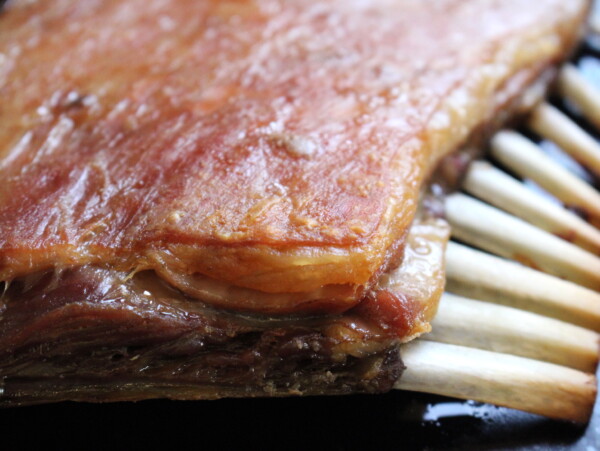
- Made with lamb: Mature lamb is the common substitution and needs no change to the method or the timing. It is milder and a little fattier than goat, and it is what most American butchers can actually get you. For a gentler introduction to cooking lamb slowly, Icelandic lamb soup uses the same cuts in a much lighter preparation.
- With chouriço: Add a few thick coins of Portuguese chouriço along with the salt pork. It brings smoke, garlic and a good deal of paprika-red fat into the sauce. Reduce the added chile a little, since chouriço carries its own.
- With potatoes in the pot: Tuck halved waxy potatoes around the meat for the last hour and a half so they cook in the wine rather than alongside it. You lose a little sauce and gain the best potatoes in the meal.
- Made with beef shank or oxtail: Neither is traditional, but both behave the way old goat does and both are easier to find. Keep everything else the same and check for tenderness at three hours. If a long braise with fruit and lamb sounds better, try Turkish lamb and apricot stew or Lebanese lamb stew with eggplant.
Serving Portuguese chanfana
In Poiares this arrives at the table in the pot it cooked in, with boiled potatoes and bread and not much else, because the sauce is the point and everything on the plate is there to carry it. Plain boiled or steamed potatoes are the traditional partner, and browned potatoes are a good upgrade if you want something with a little caramelization against the wine.
Bread matters more than it sounds like it should. You want a chewy, open crumb with a real crust, something that holds up when it is soaked rather than dissolving. Spanish sourdough bread is the closest thing on this site to a rustic Iberian loaf and it is what I make for this. For a vegetable alongside, braised red cabbage has enough acid to cut three hours of wine and fat.
Pour the same red you cooked with. Chanfana is a feast day dish, so it is worth setting out on the table whole rather than portioning it in the kitchen, and it feeds 8 generously as the center of a meal.
Storage: Leftovers keep in the refrigerator for 3 to 4 days in an airtight container, with the meat submerged in its juices so it does not dry out. Chanfana is genuinely better on day two, once the sauce has had time to settle into the meat. The fat will set into a firm cap in the fridge, which you can lift off and discard or stir back in when you reheat.
Freezing: It freezes very well for up to 3 months. Freeze the meat in its sauce, leaving a little headspace, and thaw it overnight in the refrigerator before reheating.
Reheating and make ahead: Reheat covered in a 300°F oven for 25 to 30 minutes, or gently on the stovetop with a splash of wine or water if the sauce has tightened. Avoid the microwave, which toughens the meat. You can also cook the whole dish a day ahead deliberately, refrigerate it overnight, and reheat it covered before serving, which is what I would do for a crowd.
Reprinted with permission from Authentic Portuguese Cooking by Ana Patuleia Ortins. Page Street Publishing Co. 2018. Photo Credit: Ted Axelrod.
Portuguese chanfana FAQs
Yes, and lamb is the more available option in most of the United States. Use mature lamb rather than spring lamb, ideally from an animal over about 15 pounds, since young lamb does not have the connective tissue this braise depends on. No change to the timing or the method is needed.
No. A dutch oven or a heavy metal roasting pan both work, and a dutch oven is the closest substitute. The one thing you cannot do is preheat a clay pot: it goes into a cold oven and heats up with it, or it may crack. Metal pans go into a preheated 350°F oven as usual.
A dry, everyday red with some tannin and no sweetness. A young Portuguese red from the Dão or Douro is the traditional choice and is widely available, but any dry red you would happily drink will work. Skip anything labeled cooking wine, which is salted, and skip sweet reds, which turn syrupy over three hours.
You can get tender meat that way, but you will not get chanfana. Both methods are sealed and wet, so the wine never reduces and the meat never darkens, and that final uncovered half hour in a dry oven is what gives the dish its crust and its concentrated sauce. If you use a slow cooker, cook on low for 8 hours, then transfer everything to a roasting pan and finish uncovered at 350°F for 30 minutes.
Almost always because the animal was older or the chunks were larger than the recipe assumes, and the fix is simply more time. Cover it again and give it another 20 to 30 minutes, then check with a fork, and repeat if you need to. Do not raise the oven temperature, which drives off the wine and tightens the muscle further.
Boiled potatoes and crusty bread, traditionally, with the pan juices spooned over both. A sharp vegetable such as braised red cabbage cuts the richness nicely, and for dessert the Portuguese answer is marmelada, the quince paste that also goes by membrillo in Spain. See my recipe for quince paste if you want to finish the meal properly.
That last one is worth following up on: quince paste is called marmelada in Portugal, and a slice of it with a hard cheese is how a meal like this actually ends.
More Goat & Lamb Recipes
If you tried this Portuguese Chanfana recipe, or any other recipe on Adamant Kitchen, leave a ⭐ star rating and let me know what you think in the 📝 comments below!
And make sure you stay in touch with me by following on social media!
Portuguese Chanfana (Braised Goat or Lamb)
Equipment
- 4- or 5-quart (3.6 or 4.5 L) unglazed clay pot, presoaked or a 6-quart dutch oven
- Large nonreactive bowl for marinating
- Heavy duty aluminum foil
Ingredients
Meat and marinade:
- 5 lbs goat or lamb, leg meat, or shoulder and ribs, bone in, cut into 2 1/2 to 3 inch (6.4 to 7.5 cm) chunks
- 3 to 5 cloves garlic, whole, peeled
- 1 large bay leaf, broken in half
- 1/2 cup fresh parsley, coarsely chopped
- 2 tsp sweet paprika
- 1/2 tsp crushed dried chile pepper
- 1 Tbsp coarse kosher salt, use about half as much if substituting table salt
- 3 cups red wine, dry, or more as needed to come level with the top of the meat
- 1/4 cup olive oil
For the pot:
- 1 large onion, finely chopped, divided
- 2 leaves fresh mint, optional
- 4 oz salt pork, coarsely chopped, or 3 slices bacon
Instructions
The day before:
- Place the goat or lamb chunks in a large nonreactive bowl. Add the garlic cloves, halved bay leaf, parsley, paprika, crushed chile and salt, then turn the meat until every piece is evenly coated.
- Pour the red wine over the meat until it comes level with the top of the meat, then drizzle the olive oil over the surface. Do not stir the oil in.
- Cover and refrigerate for at least 4 hours, preferably 12 hours overnight, turning the meat once or twice if convenient. Longer marinating gives a more pronounced wine flavor.
The next day:
- If using a clay pot, do not preheat the oven. Set it to 350°F (180°C) and place the loaded pot into the cold oven so it heats up gradually. A clay pot placed into an already hot oven can crack. If using a dutch oven or metal roasting pan, preheat the oven to 350°F (180°C).
- Spread half the chopped onion in an even bed across the bottom of the pot. Transfer the meat on top of it, then pour in all of the marinade, including the garlic, bay leaf and parsley.
- Scatter the remaining onion and the mint leaves over the meat, then top with the chopped salt pork or bacon so it renders down through the pot as it cooks.
- Cover tightly with the lid and a sheet of heavy duty foil crimped around the rim. Cook for 2 1/2 hours without opening the pot.
- Remove the cover and foil and cook uncovered for another 20 to 30 minutes, spooning the pan juices over the meat two or three times, until the top darkens and takes on a crust.
- Test with a fork. The meat should offer no resistance and pull away from the bone. If it is still tight, cover and cook another 20 to 30 minutes, then test again.
- Serve hot, straight from the pot, with boiled potatoes and crusty bread and the pan juices spooned over both.
Notes
Nutrition
Nutrition information is automatically calculated, so should only be used as an approximation.
More main course recipes
Find the perfect recipe
Searching for something else? Enter keywords to find the perfect recipe!

Such a delicious traditional way to enjoy goat!