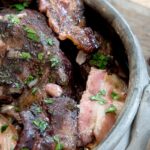
Portuguese Chanfana (Braised Goat or Lamb)
Portuguese chanfana is goat or lamb marinated overnight in red wine, then braised slowly with onions and salt pork until it falls off the bone. It is the feast day dish of Poiares, in central Portugal.
Servings: 8 Servings
Equipment
- 4- or 5-quart (3.6 or 4.5 L) unglazed clay pot, presoaked or a 6-quart dutch oven
- Large nonreactive bowl for marinating
- Heavy duty aluminum foil
Ingredients
Meat and marinade:
- 5 lbs goat or lamb leg meat, or shoulder and ribs, bone in, cut into 2 1/2 to 3 inch (6.4 to 7.5 cm) chunks
- 3 to 5 cloves garlic whole, peeled
- 1 large bay leaf broken in half
- 1/2 cup fresh parsley coarsely chopped
- 2 tsp sweet paprika
- 1/2 tsp crushed dried chile pepper
- 1 Tbsp coarse kosher salt use about half as much if substituting table salt
- 3 cups red wine dry, or more as needed to come level with the top of the meat
- 1/4 cup olive oil
For the pot:
- 1 large onion finely chopped, divided
- 2 leaves fresh mint optional
- 4 oz salt pork coarsely chopped, or 3 slices bacon
Instructions
The day before:
- Place the goat or lamb chunks in a large nonreactive bowl. Add the garlic cloves, halved bay leaf, parsley, paprika, crushed chile and salt, then turn the meat until every piece is evenly coated.
- Pour the red wine over the meat until it comes level with the top of the meat, then drizzle the olive oil over the surface. Do not stir the oil in.
- Cover and refrigerate for at least 4 hours, preferably 12 hours overnight, turning the meat once or twice if convenient. Longer marinating gives a more pronounced wine flavor.
The next day:
- If using a clay pot, do not preheat the oven. Set it to 350°F (180°C) and place the loaded pot into the cold oven so it heats up gradually. A clay pot placed into an already hot oven can crack. If using a dutch oven or metal roasting pan, preheat the oven to 350°F (180°C).
- Spread half the chopped onion in an even bed across the bottom of the pot. Transfer the meat on top of it, then pour in all of the marinade, including the garlic, bay leaf and parsley.
- Scatter the remaining onion and the mint leaves over the meat, then top with the chopped salt pork or bacon so it renders down through the pot as it cooks.
- Cover tightly with the lid and a sheet of heavy duty foil crimped around the rim. Cook for 2 1/2 hours without opening the pot.
- Remove the cover and foil and cook uncovered for another 20 to 30 minutes, spooning the pan juices over the meat two or three times, until the top darkens and takes on a crust.
- Test with a fork. The meat should offer no resistance and pull away from the bone. If it is still tight, cover and cook another 20 to 30 minutes, then test again.
- Serve hot, straight from the pot, with boiled potatoes and crusty bread and the pan juices spooned over both.
Notes
Safety, clay pots first: An unglazed clay pot must go into a cold oven and heat up with it. Placing one into a preheated oven risks cracking it. A new clay pot also needs seasoning first: fill it with water, add a few cabbage or collard leaves and some onion peelings, set it on a flameproof diffuser, bring to a boil, then simmer about 2 hours and drain. Before each use, soak the pot in water for 24 hours. Dutch ovens and metal roasting pans need none of this and go into a preheated oven.
Choosing the meat: Written for an older animal. Do not use baby goat (cabrito) or lamb under about 15 pounds (6.8 kg); young meat lacks the connective tissue a three hour braise needs and goes stringy. Shoulder and ribs work as well as leg and bring more collagen.
Pot size: The traditional pot is 4 to 5 quarts, which is snug for 5 pounds of bone in meat plus liquid. A 6-quart dutch oven is easier to work with. Pack the meat closely rather than spreading it out, since the wine is measured to the top of the meat and a wide pan needs considerably more.
Substitutions: Bacon replaces salt pork; 3 slices runs lighter than 4 oz of salt pork, so use 4 or 5 thick slices for the same richness. Chouriço can replace part of the salt pork for a smokier result. If you use table salt instead of coarse kosher, use about half the listed amount.
Method variant, dutch oven: Preheat to 350°F (180°C) and start the timer when the pot goes in. Cast iron gives up no moisture through its walls, so the sauce is thinner and more plentiful. To concentrate it, lift the meat out at the end and reduce the juices on the stovetop for 10 to 15 minutes while the meat rests under foil.
Storage: Refrigerate up to 4 days with the meat submerged in its juices, and it is better on day two. The fat sets into a cap you can lift off or stir back in. Freezes in its sauce up to 3 months. Reheat covered at 300°F for 25 to 30 minutes, or gently on the stovetop with a splash of wine. Skip the microwave.
Troubleshooting: Still tough at 3 hours means more time, not more heat; continue covered in 20 to 30 minute increments. Sauce too thin means a pan too wide or a loose cover; reduce it on the stovetop. Sauce too salty usually means table salt was measured as kosher.
Nutrition
Calories: 1010kcal | Carbohydrates: 5g | Protein: 48g | Fat: 80g | Saturated Fat: 33g | Polyunsaturated Fat: 7g | Monounsaturated Fat: 34g | Cholesterol: 219mg | Sodium: 1427mg | Potassium: 819mg | Fiber: 1g | Sugar: 1g | Vitamin A: 576IU | Vitamin C: 7mg | Calcium: 67mg | Iron: 5mg