This post may contain affiliate links. Please see our disclosure policy.
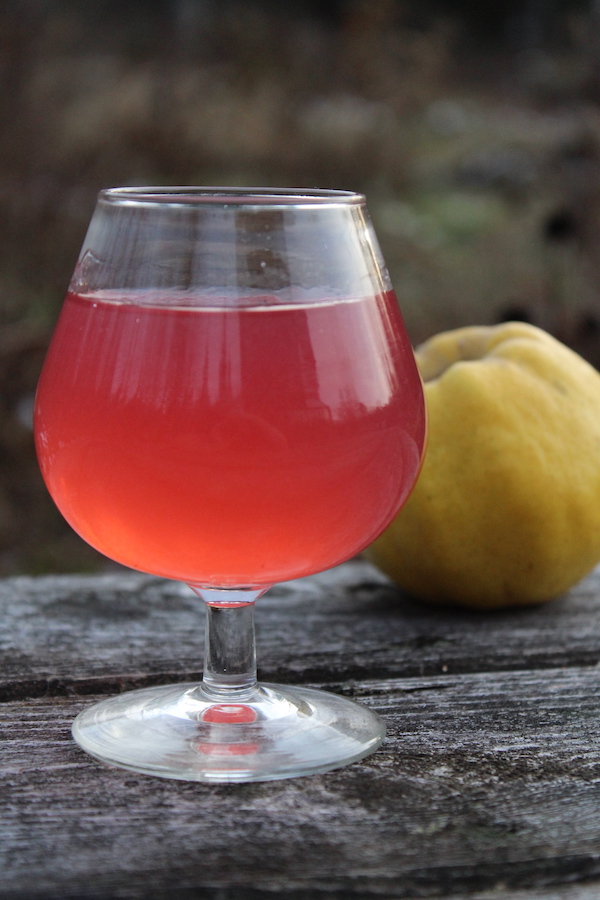
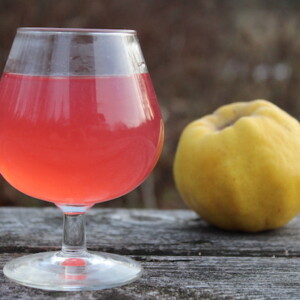
Quince liqueur captures the warm fall fragrance of quinces in a beautifully pink, gently floral vodka infusion. About 30 minutes of work plus a 2 to 3 month wait, and you have a homemade liqueur that’s somewhere between an apple brandy and a rose cordial in character, perfect for sipping straight or stirring into fall and winter cocktails.
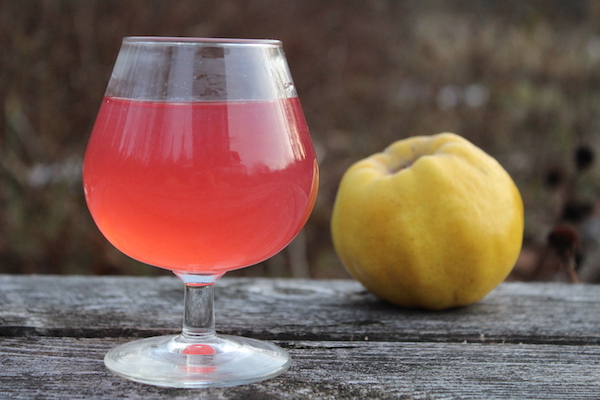
Quinces are an ancient fruit, eaten since Roman times and still beloved across the Mediterranean and Middle East, but they’re a relative rarity in American grocery stores. They look like a cross between an apple and a pear, taste astringent and woody when raw, and turn into something completely different when you cook them: a deep rosy pink, with a perfume that’s somewhere between apple, pear, and rose.
The trouble with cooking quince for liqueur is that the heat releases pectin, which clouds the alcohol and can even gel the finished bottle. The simple workaround is the recipe below: grate the raw fruit and let the vodka do the work cold, slowly, over a couple of months.
This recipe gets its color and a little bit of its character from a small handful of rose petals tossed in with the grated fruit. Rose and quince are a classic Middle Eastern pairing, often cooked together in quince jam, quince jelly, and preserves; the petals dye the liqueur a beautiful pale pink and reinforce the floral notes already present in the fruit. If you have a few last roses on the bush when quinces come into season, perfect; if not, dried edible rose petals work just as well.
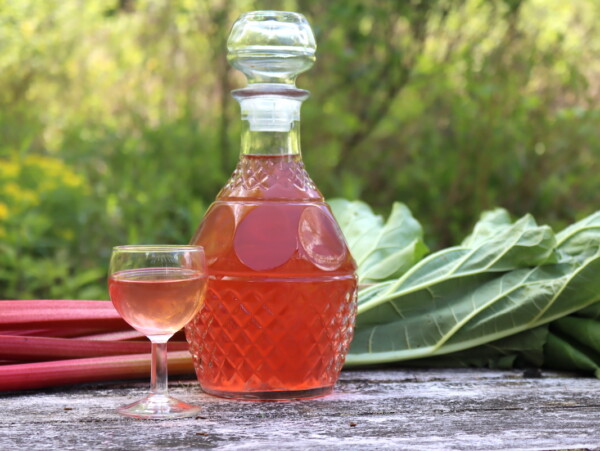
The recipe makes a single quart batch (about 3 cups of finished liqueur after straining), enough for a season’s worth of cocktails plus a couple of small gift bottles. The technique is identical to my rhubarb liqueur and dandelion liqueur, just with quince standing in for the seasonal fruit; if you’ve made either of those with me before, this will feel familiar.
Why you’ll love this classic recipe!

We planted a quince tree on our Vermont homestead the year we moved in, and watching it ripen every fall is one of the small annual rituals I look forward to most. A few quinces sitting on the kitchen counter will perfume the whole house.
By the time it’s strained and bottled, it’s almost Christmas, which means a couple of pretty pink bottles go into the holiday gift baskets and one stays at the house for hot toddies through January. It’s a slow recipe, but the quinces, the cold weather, and the time of year all conspire to make the wait feel right.
Quick Look at the Recipe
- Makes: About 3 cups of finished liqueur (24 servings, 1 oz each)
- Active prep: 30 minutes
- Infusion time: 2 to 3 months at room temperature
- Quince: 2 large bright yellow ripe quince (about 2 to 3 cups grated, skin on)
- Alcohol base: 750 ml vodka (or other neutral spirit, 80 proof or higher)
- Sugar and aromatics: 1/2 to 1 cup sugar, a small handful of rose petals (1/4 to 1/2 cup), 1 cinnamon stick (optional)
- Storage: Shelf stable at room temperature; best flavor within 1 year
Ingredients for Quince Liqueur
Five ingredients (one of them optional), all going into a single quart mason jar. The recipe is forgiving on the sugar amount, which lets you tune the finished liqueur from sharply tart to syrupy-sweet to taste.
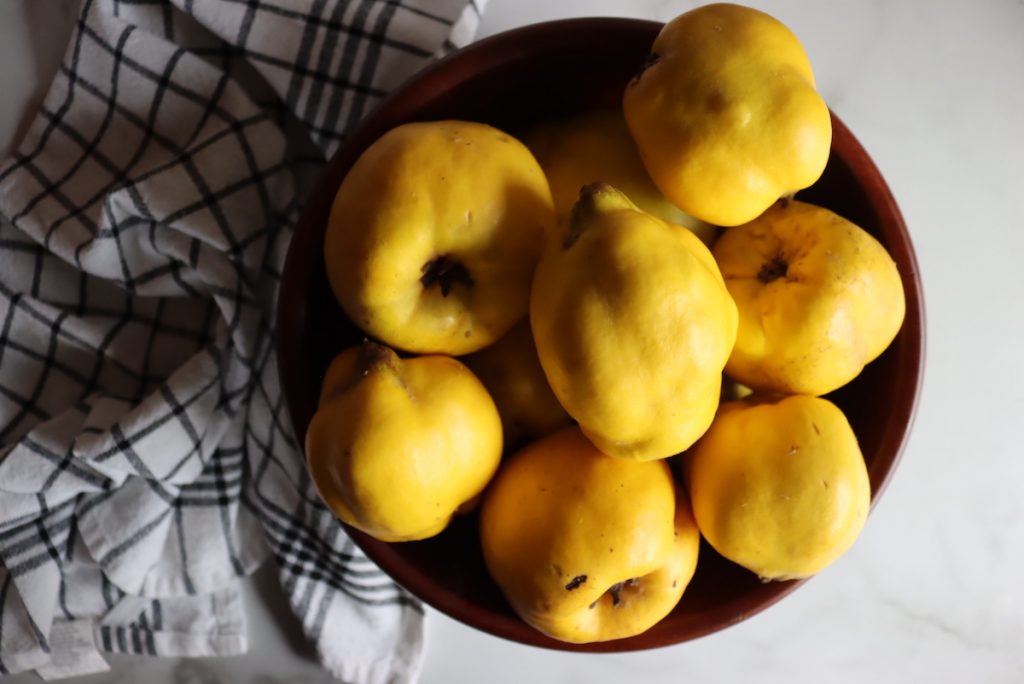
- Quince (large, ripe, fragrant): Look for quinces that are bright yellow rather than green; the green ones aren’t fully ripe and have less flavor and fragrance. Wipe off the soft fuzz on the outside with a dry cloth, but don’t peel; the skin contributes color and flavor and is fully edible. The recipe works equally well with European quince (Cydonia oblonga) and Japanese quince (Chaenomeles), though Japanese quince are smaller and you’ll need to scale the count up accordingly.
- Sugar (to taste): Quince is naturally tart and slightly astringent, so it needs sugar to balance. The recipe is forgiving on the amount; lean drier for cocktail use, or sweeter for a syrupy dessert-style cordial. Plain white sugar gives the cleanest flavor; demerara adds a slight caramel note.
- Rose petals (fresh or dried): A small handful of rose petals turns the liqueur a gorgeous pale pink and adds a subtle floral note that complements the quince beautifully. Fresh unsprayed rose petals from the garden if you have them; dried edible rose petals or buds work just as well and are easier to source. Skip them if you’d like a clear amber liqueur; the recipe still works without them.
- Cinnamon stick (optional): A single cinnamon stick adds a warm fall-spice note that suits the quince. Skip it if you’d like the finished liqueur to taste purely of quince and rose.
- Vodka (mid-grade, neutral): A mid-grade 80 proof vodka is exactly right for this. Cheap vodka has off-flavors that come through in a long infusion; top-shelf is wasted on a fruit liqueur. You can also substitute brandy for a richer, deeper finish (more on this in Variations below).
A note on quinces: Quinces ripen in late October and November in most northern climates, sometimes into early December if you’re picking from a tree. Buy or pick them when the skin is fully yellow and they smell strongly fragrant; underripe quinces are pale green-yellow and barely smell of anything. They keep well at room temperature for several weeks (and are gorgeous in a fruit bowl while they wait), so a single weekend’s haul can easily provide for both this liqueur and a batch of quince paste or other quince recipes.
How to Make Quince Liqueur
The active work is at the start (washing, grating, packing the jar) and at the very end (straining and bottling), with 2 to 3 months of room-temperature infusion in between. Plan on about 30 minutes hands-on at the start and another 15 minutes on bottling day.
Step 1. Wash and de-fuzz the quinces. Quinces have a soft white fuzz on the skin that wipes off easily with a dry cloth or paper towel. Don’t peel; the skin contributes color and flavor.
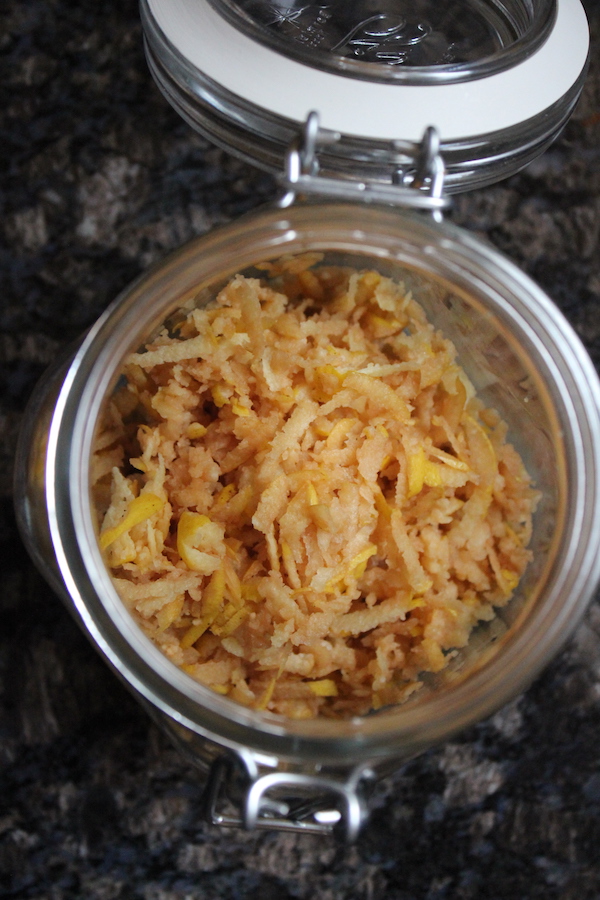
Step 2. Grate the quince. Cut around the core (quinces have an apple-like core that’s hard to cut through), then grate the flesh on the large holes of a box grater or in a food processor with the grating attachment. Skin and all goes into the grate; just discard the core. Work quickly; the grated flesh browns within minutes once exposed to air, and while it doesn’t affect safety, it does dull the final color of the liqueur.
Step 3. Pack the quince into a quart jar. Add the grated quince to a clean quart mason jar; it should fill the jar most of the way. Top with the sugar, rose petals, and cinnamon stick (if using).
Step 4. Cover with vodka. Pour the entire 750 ml of vodka over the contents of the jar, filling to within an inch of the top. The grated quince will float at first; that’s fine. Cap tightly and shake gently to mix.
Step 5. Infuse at room temperature for 2 to 3 months. Set the jar in a cool dark place (a kitchen cabinet or pantry shelf is ideal). Shake gently every few days for the first couple of weeks, then leave it alone. It’ll start tasting good after about a week, but the floral and rose notes need time to develop; 2 to 3 months gives the best balance.
Step 6. Strain. Pour the liqueur through a fine mesh strainer into a clean bowl, pressing gently on the quince to extract every drop of liqueur. For a perfectly clear finish, run a second pass through cheesecloth or a coffee filter; the grated fruit releases fine sediment that the mesh alone won’t catch. Don’t toss the strained quince yet; see Recipe Tips for what to do with it.
Step 7. Bottle and store. Use a funnel to fill clean glass bottles. Clear flip-top Grolsch bottles show off the pink color beautifully and are perfect for gift-giving. The vodka keeps the finished liqueur shelf stable at room temperature; store out of direct sunlight to preserve the color, and plan to use within a year for peak flavor.
Recipe Tips
Don’t peel the quince. The skin contributes both color and flavor, and the grating breaks it down enough that you won’t notice texture in the finished liqueur. Just wipe off the soft fuzz with a dry cloth and grate everything (skin and flesh) directly into the jar.
Save the strained quince. Don’t toss it after straining. The boozy macerated quince is fragrant, sweet, and still has plenty of flavor. Stir it into a coffee cake or quick bread batter, fold it into ganache, simmer it briefly with a splash of water and a little extra sugar to make a quick quince compote for ice cream or yogurt, or freeze it for later. It’s a lovely pairing in quince cake and similar baked goods.
Cook quince separately for any other recipe. Cooking quince is what gives it the gorgeous deep pink color and tender texture you see in jam, paste, and poached quince; the rose-pink hue in the cooked fruit is a separate phenomenon from the pale pink of this raw-grated infusion. Don’t try to substitute cooked quince for raw in this recipe. Cooked quince releases pectin that will cloud the liqueur and may even cause it to gel.
Sugar to taste, in either direction. 1 cup of sugar is a middle-of-the-road balance; the recipe works with anywhere from 1/4 cup (very dry, almost martini-like) to 2 cups (syrupy and dessert-like). Start with less than you think you’ll want; you can always stir in more after straining if the finished liqueur is too tart.
Long infusions are fine, even years. The vodka keeps everything shelf stable, and quince develops more depth and complexity with extended infusion. The flavors will start to dull after about a year of bottled storage, but in-jar with the fruit and sugar, the liqueur can sit for years and only get better.
Variations
The base recipe takes well to small changes. A few that work:
- Quince brandy: Substitute brandy for vodka. The result is richer, darker, and more like a traditional European fruit eau de vie. Cognac or a mid-grade brandy both work well; cheap brandy will dominate the quince flavor, so don’t go below something you’d drink straight.
- Quince gin: Substitute gin for vodka. The juniper plays unexpectedly well with the quince; the result is a botanical gin that mixes beautifully into a tonic. Use a clean London Dry gin rather than a heavily flavored craft gin.
- Spiced quince liqueur: Add 4 whole cloves and 3 cardamom pods with the cinnamon stick in step 3. Tastes like fall in a glass.
- Vanilla quince liqueur: Add half a split vanilla bean to the jar with the vodka. The vanilla deepens the floral notes and gives the liqueur a creamy, dessert-like quality.
- Ayva likörü (Turkish quince liqueur): The Turkish version skips the rose petals and adds a strip of lemon peel, half a vanilla bean, and a couple of whole cloves. The result is amber rather than pink, and reads more like a pomace brandy than a floral cordial.
- Other fruits, same method: The grate-and-infuse technique works with any tannic, fragrant fruit. Rhubarb liqueur, black currant liqueur, and crab apple all use a close cousin of this recipe.
Quince Liqueur Cocktails
Quince liqueur slips into all the same drink slots as St-Germain, Aperol, or a fruit brandy. The pale pink color and gentle floral character make it especially good in autumn and holiday cocktails. A few of my favorites:
- Quince and ginger beer: 2 oz quince liqueur, top with ice-cold ginger beer, garnish with a slice of lemon. Ginger beer’s bright spice plays perfectly against the floral quince. The simplest and arguably best use.
- Quince spritz: 1 1/2 oz quince liqueur, top with prosecco or sparkling wine, splash of soda water, garnish with a thin slice of fresh quince or a lemon twist. A pink autumn alternative to an Aperol spritz.
- Quince hot toddy: 1 1/2 oz quince liqueur, 1 tsp honey, juice of half a lemon, top with hot water. The autumn cousin to the rhubarb hot toddy; warming, floral, and exactly right for the first cold night of the year.
- Quince martini: 2 oz gin or vodka, 1 oz quince liqueur, dash of orange bitters, stir with ice and strain into a chilled coupe.
- Quince and apple cider: 1 1/2 oz quince liqueur stirred into a mug of warm spiced apple cider. A pretty pour at any fall gathering.
- Quince sour: 2 oz quince liqueur, 1 oz bourbon, 3/4 oz lemon juice, 1/2 oz simple syrup, shake with ice and strain. The bourbon grounds the floral notes; gorgeous as a holiday cocktail.
For more drinks ideas, see my collections of rhubarb cocktails, or my homemade elderflower cordial, which all play in similar territory.
Great recipe. I’ve made it a couple of times before. I only add 1/2 cup of sugar. It is excellent with ginger beer. Our quince are ripe, and there are still some roses in yard, so I’m about to make another batch!
No. Wipe off the soft fuzz on the outside with a dry cloth, but leave the skin on. The skin contributes color and flavor to the finished liqueur, and the grating breaks it down enough that you won’t notice any texture. Just core the quince (cut around the apple-like core and discard it) and grate everything else, skin and all, directly into the jar.
Don’t throw it away. The strained quince is sweet, fragrant, and still has plenty of flavor. Stir it into coffee cake or quick bread batter, fold it into ganache or buttercream, simmer it briefly with a splash of water for a quick compote to top ice cream or yogurt, or freeze it in a zip-top bag for later. It’s a small bonus from the recipe and makes a lovely cake-and-liqueur set.
No. The vodka keeps the finished liqueur shelf stable at room temperature, both during the 2 to 3 month infusion and after bottling. Store out of direct sunlight to preserve the pink color, and plan to use it within a year for peak flavor. The liqueur won’t spoil after a year, but the floral and rose notes will gradually fade.
Yes to both. Brandy makes a richer, darker liqueur in the style of a traditional European eau de vie. Gin works beautifully too; the juniper complements the quince and the result mixes well with tonic. The technique is identical for either; just substitute the same volume of brandy or gin for the 750 ml of vodka. Whiskey will dominate the floral quince flavor and isn’t recommended.
Quince liqueur tastes floral and gently fruity, somewhere between an apple-pear brandy and a rose cordial. The quince contributes a perfumed warmth that’s hard to describe but instantly recognizable to anyone who’s smelled a ripe quince; the rose petals add a subtle floral note that complements rather than overpowering. It’s noticeably less sweet than St-Germain or Chambord, and noticeably more aromatic than a plain fruit-infused vodka.
Quince Recipes
50+ Quince Recipes (How to Cook Quince)
Quince recipes can be hard to find, as this deliciously fragrant fruit isn’t used as much as it once was.…
If you tried this Quince Liqueur recipe, or any other recipe on Adamant Kitchen, leave a ⭐ star rating and let me know what you think in the 📝 comments below!
And make sure you stay in touch with me by following on social media!
Quince Liqueur
Equipment
Ingredients
- 2 large ripe quince, about 2 to 3 cups grated, skin on
- 1/2 to 1 cup granulated sugar, start with less; you can add more after straining
- 1/4 to 1/2 cup fresh unsprayed rose petals, or 2 tablespoons dried edible rose petals
- 1 whole cinnamon stick, optional
- 750 ml vodka, or other neutral spirit, 80 proof or higher
Instructions
- Wash the quince and wipe off the soft fuzz on the outside with a dry cloth. Don't peel; the skin contributes color and flavor.
- Cut around the apple-like core of each quince and discard. Grate the remaining flesh and skin on the large holes of a box grater or in a food processor with the grating attachment. Work quickly; the flesh browns within minutes.
- Pack the grated quince into a clean quart mason jar. Top with sugar, rose petals, and a cinnamon stick if using.
- Pour 750 ml vodka over the contents, filling the jar to within an inch of the top. Cap tightly and shake gently to mix.
- Store at room temperature, out of direct sunlight, for 2 to 3 months. Shake gently every few days for the first couple of weeks, then leave undisturbed.
- Strain through a fine mesh strainer, pressing gently on the solids to extract every drop of liqueur. For a clearer finish, run a second pass through cheesecloth or a coffee filter.
- Taste, and add more sugar if you’d like a sweeter finish (it dissolves easily into the room-temperature liqueur with a few minutes of stirring).
- Bottle in clean glass bottles. Store at room temperature, out of direct sunlight. Use within 1 year for peak flavor.
Notes
Nutrition
Nutrition information is automatically calculated, so should only be used as an approximation.
Find the perfect recipe
Searching for something else? Enter keywords to find the perfect recipe!
Great recipe. I’ve made it a couple of times before. I only add 1/2 cup of sugar. It is excellent with ginger beer. Our quince are ripe, and there are still some roses in yard, so I’m about to make another batch!
Thanks.
I’m so glad you like it!
Hi, I was wondering how long the completed product will last before loosing some of its floral fragrance?
Thank you!!
note: I’m trying to determine how far ahead I can make it.
Hi Cheryl. liqueur infusions can last up to a year before they begin to degrade.
Thank you for this recipe. I made some last season & all bottled ready to go! Do you have any recommendations for mixtures or cocktails for this? Thanks again for sharing.
Hello,
This recipe sounds intriguing. Do you peel the quince before shredding?
I second the request for cocktail recipes using quince liquor.
Thank you,
Julie
Hi Ashley,
A couple of years ago I decided to have a go at making my own quince liqueur, using korn and various combinations of spices and instead of leaving for 2-3 months, the jars are still there. I don’t believe that the fruit would deteriorate in the alcohol during this time and it looks OK, looking at the jars. As I have never tried this before I was wondering what your opinion would be?
I now have around 250 quince from my tree and probably another 100 at least still on the tree, so I will have another go, and try your recipe too.
I left the skins on, cut off the four sides of the fruit and grated it in my Cuisinart. Two Quinces filled the quart jar. Fresh rose leaves from my garden and a dash of cinnamon as I was out of sticks. I mixed the fruit with the sugar in a seperate bowl. Once incredients were mixed I stuffed them back into the quart jar. and covered with Vodka.
I really want to make the grated quince into something else now, I have taken the vodka off, and am drinking it and it is delicious, but what to do with the grated quince? Any recipe suggestions ? eg cake?
Thanks for this recipe it is delicious
You’re welcome! It could make a lovely addition to cakes, cookies, ganache, etc.