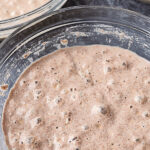
Whole Wheat Sourdough Starter
Whole wheat sourdough starter takes just flour, water, and a week of small daily feedings. Once it doubles after every feeding, it's ready to raise any sourdough bread you want to bake.
Servings: 1 servings, makes one starter
Equipment
Ingredients
Day 1
- 50 g whole wheat flour see notes for cups
- 50 g water room temperature
Each daily feeding, days 2 to 7
- 30 g whole wheat flour
- 30 g water room temperature
Instructions
- Day 1: In a clean quart jar, stir the day 1 flour and water together until there's no dry flour left. Scrape down the sides, rest the lid on top without sealing it, and leave it at room temperature, ideally 70 to 78°F, for 24 hours.
- Days 2 and 3: Each day, stir in one daily feeding of flour and water, scrape down the sides, and cover the jar loosely.
- Day 4: Remove and discard about half of the starter, then stir in one daily feeding.
- Day 5: Stir in one daily feeding, without discarding any starter.
- Day 6: Remove and discard about half of the starter again, then stir in one daily feeding.
- Day 7: Stir in one daily feeding. The starter is ready when it roughly doubles within 6 to 8 hours of each feeding and smells pleasantly sour. If it isn't there yet, keep feeding it once a day and discarding half every other day until it is.
- Use what you need for your first loaf, close the lid on the rest, and store it in the fridge (see notes for weekly feeding).
Notes
Measuring: Weighing works best. By volume, 50 g of whole wheat flour is about 7 tablespoons and 30 g is about 1/4 cup. For the water, 50 g is 3 1/2 tablespoons and 30 g is 2 tablespoons.
What to expect: A big rise on day 2 followed by a few quiet days is normal, and so is a cheesy or vinegary smell around days 3 and 4. Keep feeding on schedule.
Fridge care: Once a week, keep about 50 g of starter, discard the rest, and feed it 50 g of whole wheat flour and 50 g of water. Leave it out for 1 to 2 hours, then refrigerate.
To bake: Let it come to room temperature, then feed it equal weights of flour and water that add up to what your recipe needs. Use it at its peak, when it's domed and bubbly.
Other grains: Einkorn, spelt, emmer, and khorasan use the same method. For dark rye, use 15 g (1 tablespoon) more water than flour at first, then equal weights once it's rising reliably.
Hot weather: Park the starter in the fridge during the hottest part of the day. If it turns thin, stir in a little flour with no water.
When to throw it out: Pink or orange streaks or fuzzy mold mean it's time to start over. Gray liquid on top is hooch, so stir it in or pour it off, and feed the starter.
Source: Adapted with permission from Whole Grain Sourdough at Home by Elaine Boddy (Page Street Publishing Co., 2020).
Nutrition
Calories: 272kcal | Carbohydrates: 58g | Protein: 11g | Fat: 2g | Saturated Fat: 0.4g | Polyunsaturated Fat: 1g | Monounsaturated Fat: 0.2g | Sodium: 2mg | Potassium: 290mg | Fiber: 9g | Sugar: 0.3g | Vitamin A: 7IU | Calcium: 27mg | Iron: 3mg