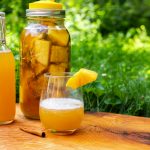
Tepache
Tepache is a wonderful, effervescent, lightly fermented pineapple beverage popular in Mexico. It is made from the skins and core of pineapple; you can enjoy the fresh pineapple flesh and also make use of the parts typically discarded in order to enjoy it over a longer period of time.
Servings: 4 Servings (about 1 quart)
Ingredients
- 1/2 cup sugar ideally piloncillo or dark brown sugar, but white sugar will work, see notes
- 1 Medium Pineapple
Just the Peel and Core, eat the rest of the fruit, cut into 1- to 2-inch pieces
- 1 Medium cinnamon stick
optional, and/or a few whole cloves and/or other spices
- 4 to 5 cups filtered or non-chlorinated water enough to fill a 1/2 gallon jar with 2 inches of headspace
- 4 whole cloves optional
- 4 whole allspice berries
Instructions
- Rinse the pineapple gently under cool water and pat dry. Do not scrub it; the wild yeast that ferments tepache lives on the skin.
- Slice off the leafy crown and discard. Stand the pineapple upright and cut the skin away in long vertical strips, keeping a thin layer of yellow flesh attached. Cut out the inner core. Reserve the inner flesh for another use.
- Add the pineapple skin and core to a 1/2 gallon (64 oz) wide mouth mason jar. Add the sugar, cinnamon stick, and any optional spices.
- Pour cool water over everything until the jar is mostly full, leaving 2 inches of headspace at the top (about 4 to 5 cups of water).
- Cover the jar loosely with a clean cloth and rubber band, or with a silicone pickle pipe. Do not seal tightly; carbon dioxide builds up during fermentation.
- Set the jar somewhere out of direct sunlight at room temperature (68 to 75 F). Ferment for 2 days in warm weather or 3 days in cooler weather, until you see steady bubbling and a light foam on top.
- Strain the tepache through a fine mesh strainer into a clean bowl. For a clearer drink, strain a second time through cheesecloth.
- Pour into clean glass bottles, leaving an inch of headspace. Refrigerate immediately to stop the fermentation and lock in the carbonation.
- Serve cold over ice. Yields about 1 quart. Best within 1 to 2 weeks.
Notes
Pineapple: A ripe pineapple is essential. The base should smell sweet, the leaves should pull out easily, and the fruit should give slightly when pressed.
Sugar substitutions: Piloncillo is traditional and gives the deepest flavor; dark brown sugar is the easiest substitute. Granulated sugar works but produces a thinner-tasting drink. Honey can be substituted at 1/2 cup raw honey; use a darker honey for closer-to-traditional flavor.
Sweeter version: For a sweeter finished drink, increase the sugar up to 1 cup. The wild yeast will happily eat the extra. Most of the sugar is consumed during the 2 to 3 day ferment regardless, so the finished drink is much less sweet than the starting liquid.
Water: If your tap water has a strong chlorine smell, leave it uncovered overnight before using or use filtered water. Chlorine can slow or stall the wild yeast.
Headspace and pressure safety: Leave at least 2 inches of headspace at the top of the fermenting jar, and never seal the jar tightly during the 2 to 3 day ferment. A loose cloth, a pickle pipe, or a screw lid set on top without tightening all let the gas escape safely.
White film on top: A thin, papery, off-white film that appears after the first day or two is harmless kahm yeast — skim it off before straining. Real spoilage looks different: fuzzy, raised mold in green, blue, black, or pink. If you see fuzzy colored mold, discard the batch.
Storage: Refrigerated tepache keeps for 1 to 2 weeks. Flavor is brightest in the first week. Open bottles carefully; the carbonation can be lively.
Variations: See the post for spiced (extra cloves and allspice), ginger, honey, whole-pineapple, and tepache de jamaica (hibiscus) variations.
Nutrition
Serving: 1cup | Calories: 130kcal | Carbohydrates: 33g | Protein: 0.2g | Fat: 0.2g | Saturated Fat: 0.01g | Polyunsaturated Fat: 0.03g | Monounsaturated Fat: 0.01g | Sodium: 2mg | Potassium: 81mg | Fiber: 1g | Sugar: 31g | Vitamin A: 6IU | Vitamin C: 6mg | Calcium: 17mg | Iron: 0.3mg