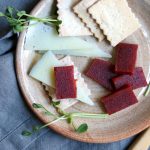
Quince Paste
Quince paste, or Spanish membrillo, is just quinces, sugar, and lemon juice, cooked down until it's firm enough to slice. Most of the cooking time is hands-off.
Servings: 48 servings, makes about 3 pounds
Equipment
- Food processor
- Parchment Paper
Ingredients
- 3 1/2 lbs. quinces whole, weighed before coring
- 8 cups water
- 4 cups granulated sugar
- 1/4 cup lemon juice fresh or bottled, about 2 lemons
Instructions
- Rinse the quinces and rub off any fuzz. Quarter them, cut out the cores and seeds, and cut away any bruised or dark spots. Leave the skins on.
- Put the quinces in a large Dutch oven with the water. Cut a round of parchment paper to fit inside the pot and lay it on the surface of the water.
- Bring it to a boil over high heat, then cover the pot, turn the heat to medium-low, and simmer about 1 1/2 hours, until a knife slides into the quinces easily.
- Drain the quinces in a colander set over a large bowl, saving the cooking liquid. You should have about 5 cups.
- Pour the liquid back into the pot and boil it, uncovered, over medium-high heat until it's down to about 3 cups, 12 to 15 minutes.
- Meanwhile, purée the cooked quinces in a food processor until completely smooth, about 45 seconds, scraping down the bowl as needed.
- Press the purée through a fine-mesh strainer a little at a time, and discard the bits of skin and fiber. You should have about 4 cups of purée.
- Heat the oven to 350°F with a rack in the middle. Grease an 8-inch square baking pan and line it with parchment paper.
- Stir the purée into the reduced liquid in the pot, then add the sugar and lemon juice. Bring it to a boil.
- Turn the heat to medium-low and simmer, stirring now and then, until the mixture darkens, thickens, and starts to spatter, about 30 minutes.
- Move the uncovered pot to the oven and bake for 1 to 1 1/2 hours, stirring and scraping down the sides every 15 minutes. It's done when it has turned deep red to rusty brown and a spatula leaves a clear trail across the bottom of the pot.
- Scrape the paste into the lined pan and smooth the top. Let it cool completely on the counter, then refrigerate it until firm, at least 4 hours.
- Turn the pan over onto a cutting board and peel off the parchment. Cut the paste into bars or squares with a heavy knife, rinsing the blade in cold water between cuts.
- Wrap each piece in parchment paper. For anything you'll keep longer than a month, add a layer of plastic wrap over the parchment.
Notes
Source: This recipe follows the quince paste from America's Test Kitchen.
Weighing: Weigh the quinces whole, before coring. They vary a lot in size, so a count doesn't work.
Doneness: Go by the spatula trail across the bottom of the pot. The color can run from deep red to rusty brown.
From jelly pulp: If you cored the quinces before cooking them for jelly, blend the leftover pulp smooth, press it through a strainer, and measure it. Use about 4 cups of sugar and 1/4 cup of lemon juice for every 4 cups of purée, and start at step 9 without the cooking liquid. It thickens a little sooner.
Storage: Wrapped in parchment and then plastic wrap, quince paste keeps up to 6 months in the fridge, or up to a year in the freezer.
Nutrition
Serving: 1oz | Calories: 76kcal | Carbohydrates: 20g | Protein: 0.1g | Fat: 0.1g | Saturated Fat: 0.003g | Polyunsaturated Fat: 0.01g | Monounsaturated Fat: 0.01g | Sodium: 1mg | Potassium: 41mg | Fiber: 0.4g | Sugar: 17g | Vitamin A: 8IU | Vitamin C: 4mg | Calcium: 2mg | Iron: 0.2mg