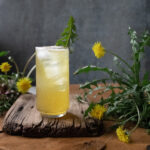
Dandelion Infused Gin
A quick foraged-spring infusion that turns London Dry gin into a bright, honey-floral spirit in as little as 2 hours. Perfect for spring gin and tonics, cocktails, and martinis.
Servings: 16 servings, Makes about 2 cups
Equipment
Ingredients
- 2 cups London Dry Gin
- 1/2 cup fresh dandelion blossoms whole flowers for short infusion; petals only for infusions over 24 hours
- 1 Tbsp roasted ground dandelion root or 1 dandelion root tea bag
Instructions
- Forage 1/2 cup of fully open dandelion blossoms from an unsprayed area on a sunny morning. Process within an hour or two of picking.
- For an infusion of 2 to 24 hours, use whole flowers (sepals and all). For longer infusions up to 2 weeks, pinch off the green sepals and use only the yellow petals to avoid bitterness building up.
- Add the dandelion blossoms (or petals), gin, and roasted ground dandelion root if using to a clean quart jar. Cap tightly and shake gently to mix.
- Infuse at room temperature, out of direct sunlight. The gin will start to turn pale gold within an hour.
- Strain through a fine mesh strainer. For a perfectly clear gin, run a second pass through cheesecloth or a coffee filter (the dandelion root can leave fine sediment).
- Bottle in a clean glass bottle. The original gin bottle works well. Store at room temperature, out of direct sunlight, for up to 1 year.
Notes
Whole flowers vs. petals. The choice depends entirely on infusion time. Under 24 hours, whole blossoms work well; the green sepals contribute pleasant bitterness in a short window. Over a few days, switch to petals only or the bitterness will overwhelm the floral notes.
The dandelion root matters. The 1/2 teaspoon of roasted ground dandelion root is technically optional but contributes important tannin and depth. Without it the gin reads as floral but a little thin in cocktails. Substitute a single bag of dandelion root tea (opened up and used loose) if you don't have ground root.
Pick on a sunny morning. Dandelion blossoms are at their fullest and most fragrant in mid-morning sun. Pick after the dew has dried but before midday heat starts to wilt the flowers. Avoid overcast days when blossoms tend to stay half-closed.
Plant identification. Use common dandelion (Taraxacum officinale). Lookalikes including coltsfoot, hawkbit, hawksbeard, and cat's ear all have superficially similar yellow blossoms but different leaves and stems. Real dandelions have a single hollow stem with no branches and a basal rosette of jagged-edged leaves.
Foraging safely. Pick from yards, pastures, and fields that haven't been sprayed with herbicides or pesticides, well away from busy roads.
Storage. Shelf stable at room temperature for at least a year. The floral notes will start to fade slowly after that, but the gin won't spoil.
Recipe attribution. Adapted with permission from Slow Drinks by Danny Childs, published by Hardie Grant Publishing in October 2023.
Nutrition
Calories: 69kcal | Sodium: 0.3mg | Potassium: 1mg | Iron: 0.01mg